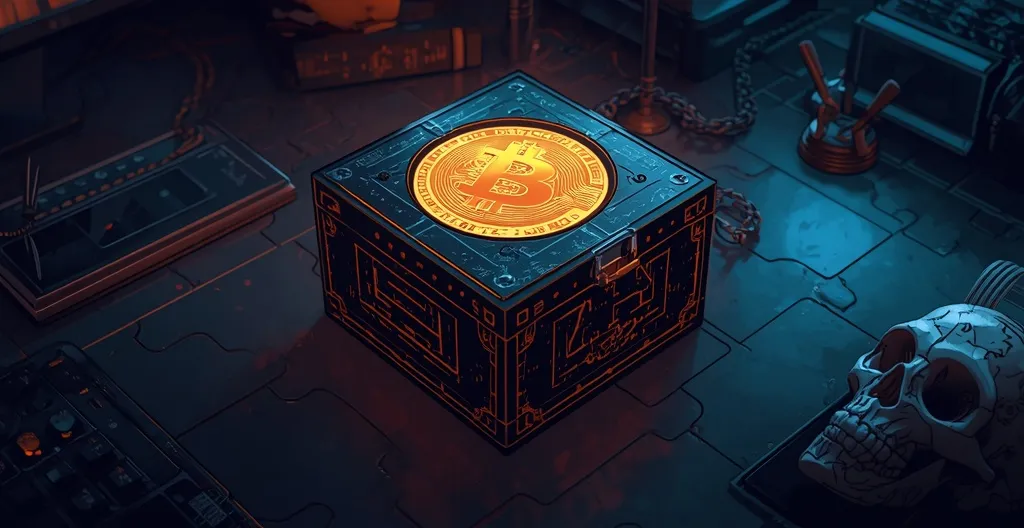
Someone appears to have turned Bitcoin’s Genesis Block into a puzzle box, and not a very secure one.
- Public Genesis Block data appears to be the basis of a wallet puzzle.
- OP_RETURN was used to embed a 255-byte message on Bitcoin.
- Low-entropy brainwallet design is the real technical red flag.
- Paid clues were reportedly offered in exchange for Bitcoin transfers, though that setup is unverified here.
Bitcoin’s Genesis Block, Block 0, mined by Satoshi Nakamoto in 2009, has resurfaced in a very Bitcoin kind of way: as the apparent input for a wallet puzzle built from public data. If the reported setup is accurate, the creator used information from that first block to derive a private key, then left a message on-chain explaining the stunt.
The whole thing is equal parts crypto lore and cautionary tale. The lore comes from Satoshi’s first block. The cautionary tale comes from the fact that using public, guessable data as key material is a terrible security habit.
According to the notes, the message was embedded in Bitcoin using OP_RETURN, a transaction field that lets users attach arbitrary data to the chain. That data is public, not hidden. In this case, the message was said to be 255 bytes long and placed in a 500-byte transaction, but those specific size claims could not be independently verified from the available material and should be treated carefully.
The broader idea is clear enough: the puzzle was intentionally built with weak entropy. In cryptography, entropy means unpredictability. High entropy makes keys hard to guess. Low entropy makes them vulnerable because the inputs are obvious, public, or easily reconstructed. If a private key comes from something everyone can see on-chain, it is not much of a secret.
The message itself doesn’t exactly hide the ball:
“I created a Bitcoin puzzle using information from Satoshi's Genesis Block to generate a wallet. The entropy is extremely low. I did not even need to make backups, everything required was already in the first block. Good luck!”
That is a neat line. It is also a confession of bad key hygiene dressed up as a scavenger hunt.
The term for this kind of setup is brainwallet: a wallet whose private key is derived from human-chosen or predictable input rather than strong random generation. Brainwallets are notorious for getting drained because attackers can reproduce the same input and derive the same key. A “brainwallet” built from public blockchain data is especially ugly. The words “secure” and “publicly guessable secret” do not belong in the same sentence unless you are trying to sell disaster.
The Genesis Block is an obvious place to build a Bitcoin puzzle because it carries so much historical weight. Bitcoin’s first block contains the famous text string:
“The Times 03/Jan/2009 Chancellor on brink of second bailout for banks.”
That line came from a London newspaper headline and has long been read as a pointed comment on the banking system after the financial crisis. Whether Satoshi meant it as a political statement, a timestamp, or both, it became part of Bitcoin’s origin myth.
So if someone wants to create a Bitcoin puzzle with instant recognition and a built-in aura of mystique, Genesis Block data is the obvious raw material. It is the deepest lore in the system. Every Bitcoin old-timer knows it. Every newcomer can Google it in five seconds. That is exactly why it works as puzzle fuel, and why it is such a weak source of real entropy.
One detail that stands out, at least according to the notes, is a clue system where people can send Bitcoin to a specified wallet address to receive hints, with larger transfers supposedly unlocking more useful clues. That may be part of the puzzle, or it may be a very polished way to pull value from curious people who like riddles and have more sats than skepticism. In crypto, those two things sometimes travel together.
Important caveat: several of the more specific claims here, including the block number where the activity was spotted, the byte counts, the fee, and the paid-clue mechanics, were not independently verified from the material available. So the historical backdrop is solid, but the finer details should be read as reported claims, not settled fact.
That said, the underlying lesson is not in doubt. Public data is not entropy. If a wallet key is derived from information that anyone can reconstruct, it is only as private as the most determined guesser in the room. And in crypto, there are plenty of those. Some are researchers. Some are opportunists. Some are just bots chewing through bad keys like a wood chipper with Wi-Fi.
Bitcoin has always been brutally honest about this. It rewards discipline and punishes laziness. Strong randomness matters. Backups matter. Human memory is not a security model. If the puzzle really does rely on Genesis Block data alone, then it is less a feat of cryptography than a demonstration of how not to build a wallet.
Key questions and takeaways
-
What is Bitcoin’s Genesis Block?
It is Bitcoin’s first block, also known as Block 0, mined by Satoshi Nakamoto in 2009. It matters because it marks Bitcoin’s origin and contains the famous newspaper headline embedded in the coinbase data. -
What does OP_RETURN do?
OP_RETURN lets users attach arbitrary data to a Bitcoin transaction. It is useful for messages or metadata, but many Bitcoiners dislike it because it consumes blockspace for non-monetary data. -
Why is a Genesis Block-based brainwallet risky?
Because the inputs are public and predictable. A brainwallet built from known data has low entropy, which makes the private key easier to reproduce or brute-force. -
Are all the puzzle details verified?
No. The Genesis Block history is well established, but the specific claims about the on-chain activity, size, fee, and clue system were not independently confirmed in the available material. -
What is the real lesson here?
Public information is not a substitute for randomness. If a private key can be derived from widely known data, it is not a strong secret, it is a liability waiting to be drained.
Bitcoin can host serious money, weird art, historical callbacks, and the occasional cryptographic sideshow. This one appears to be all four. Fun? Sure. Clever? Maybe. Secure? Not even close. Mathematics does not care how poetic the backstory is.
Further reading
A few related pieces that add more color to the Genesis Block puzzle and the OP_RETURN debate:
- Someone Deciphered Bitcoin Puzzle Into Genesis Block Data
- Bitcoin OP_RETURN Message Claims Genesis Block Wallet Puzzle Without Proof
- Samson Mow Blames Bitcoin Core for BIP-110 Backlash as OP_RETURN Fight Escalates
- Bitcoin Core v30.0 Released: Fee Cuts, Upgrades, and OP_RETURN Controversy Ignite Debate