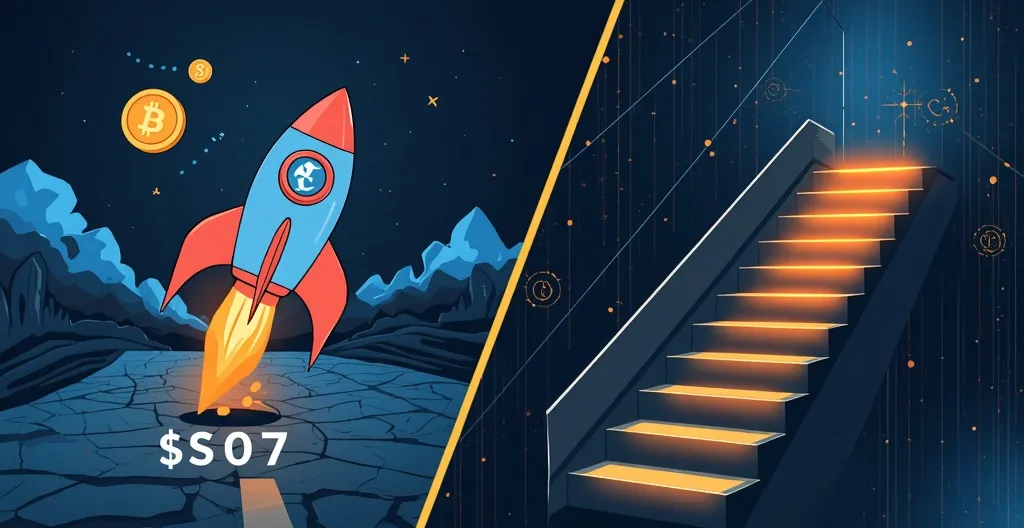
XRP at $1 and Dogecoin at $0.07: one has the bigger moonshot, the other has the sturdier floor
Dogecoin and XRP are both nursing brutal drawdowns from recent highs, but they are not recovering for the same reasons. Dogecoin near $0.07 still looks like a meme-driven bet on collective irrationality. XRP near $1 looks like a payments token trying to rebuild a more durable base, as seen on the XRP Ledger Home.
- DOGE: more speculative upside, weaker fundamentals
- XRP: stronger liquidity, utility, and institutional support
- Both: still at the mercy of sentiment, macro liquidity, and crypto’s usual chaos
That difference matters. Cheap is not the same thing as promising, and a big drawdown does not automatically mean value. Sometimes a token is down because the market overreacted. Sometimes it is down because the market finally stopped pretending.
The cleaner question is simple: which one has the better recovery setup from here?
Dogecoin: huge upside if the crowd returns, but the chart is still ugly
Dogecoin’s case has always been blunt: it is a retail sentiment machine with one of the strongest brands in crypto. It reportedly lost about 90% from its May 2021 all-time high near $0.73, and the price action since then has been violently cyclical rather than organically constructive.
It had a major 2024 rally from around $0.09 to roughly $0.48, then another sharp push in April 2025 from about $0.13 to $0.30. That is classic DOGE behavior, big bursts, fast reversals, and plenty of traders confusing adrenaline with a thesis.
Since then, the structure has weakened. The chart setup described here shows lower highs and lower lows, with DOGE trading mainly below $0.157 since the beginning of 2026 and down more than 50% during 2026. Support near $0.067 has held so far. If that breaks, the next downside area is around $0.04.
For newer readers: support is a price zone where buyers have historically stepped in and slowed a decline. Lower highs and lower lows means each bounce and each selloff has been weaker than the one before, which is usually a bearish sign. Technical analysis is not a crystal ball, but it does help show where market participants have recently cared.
Dogecoin also has a supply problem that gets hand-waved way too often. Miners receive about 5.3 billion new DOGE each year. That does not make upside impossible, but it does mean the market has to absorb fresh supply constantly. Inflation is fine when demand is roaring. It is a headache when the crowd gets bored.
Still, DOGE is not without strengths. It has strong liquidity, massive name recognition, and a retail base that never quite disappears. It reportedly has between 6 million and 8 million holders. That is a lot of people who know exactly what they own, even if the reason sits somewhere between irony and conviction.
The bigger question is whether any real catalysts show up. One possible boost would be X Money supporting DOGE for payments or tipping, though that remains speculative unless and until it is actually implemented. The DOGE 1 satellite is another publicity angle that could revive attention. Doginals and DRC-20 tokens could also add more network activity. Lower interest rates would likely support speculative assets broadly, and clearer U.S. commodity treatment could reduce some legal uncertainty.
Even then, the recovery math is unforgiving. A move from $0.07 to $0.30 would be more than 300%. Reclaiming the old $0.74 peak would require an advance of more than 900%. That is why Dogecoin is still a trader’s coin: exciting, loud, and brutally dependent on the crowd showing up in a good mood.
Technically, DOGE had been trading within a broad ascending channel after its 2021 collapse before breaking below it. A channel is just a price range between two trend lines, and when price falls out of the lower side, the market usually needs a strong catalyst to climb back in. If DOGE does recover that channel, the upper boundary above $0.47 could come back into play. From $0.07, that would be a gain of more than 560%.
XRP: less flashy, more credible, and built on a stronger base
XRP’s recent run was sharper and more structured. Its strongest advance began in November 2024, when it climbed from around $0.50 to approximately $3.30, a rally close to 600%. It later reached a new high near $3.60 in July 2025. Since then, it has dropped around 72% from that peak and now trades close to $1.
The $1 area has been important since November 2024, and XRP recently closed slightly below it before trying to reclaim it. If that retest fails, the next downside area is around $0.73. A deeper slide could carry XRP toward the lower boundary of its descending channel near $0.57, which would remove more than 40% from current levels.
That is the risk. The reason XRP still looks stronger than DOGE is what sits underneath the chart.
The XRP Ledger has deeper liquidity, and wallets holding more than 1 million XRP have reportedly increased balances near the $1 level. Active addresses on the XRP Ledger have also increased by more than 84%. The network can process around 1, 500 transactions per second, which is the kind of throughput that matters if a chain wants to be taken seriously for payments or settlement.
For readers who are not deep into blockchain plumbing: liquidity means an asset can be bought or sold without moving the price too violently. Active addresses are a rough gauge of network participation, though they are not perfect on their own. More activity does not automatically mean more value, but it does suggest the chain is not just sitting there collecting dust.
XRP also has a different supply setup from Dogecoin. Ripple faces monthly escrow releases of up to 1 billion tokens, though unused tokens are often returned to escrow. XRP transaction fees are permanently burned, but the burn is tiny and should not be oversold as some dramatic deflationary miracle. It is a modest supply sink, not a magic wand.
The broader bull case is more structural than DOGE’s. XRP is tied to payments, cross-border transfers, liquidity provisioning, and increasingly to tokenization narratives. If the CLARITY Act brings clearer U.S. crypto rules, that could reduce some regulatory fog. Continued XRP ETF inflows, if they remain strong, would support the institutional demand case. Wider adoption of Ripple’s RLUSD stablecoin could also boost XRP Ledger usage and liquidity. Real-world asset tokenization may create additional demand for infrastructure like the XRP Ledger.
That does not mean XRP is suddenly a saint. A big chunk of the market still trades it as a speculative narrative asset, and legal or regulatory uncertainty can still hit sentiment hard. But compared with Dogecoin, XRP has more than one way to matter. That is a better place to stand when the market turns ugly.
What the charts are really saying
The technical picture favors XRP on structure, even if DOGE has the more explosive upside if sentiment goes feral again. Both assets have been punished, both remain vulnerable, and both are still hostage to market liquidity. But they are not equally built.
Dogecoin broke below a broad ascending channel after its post-2021 decline. XRP also trades within a channel, but its price has not broken down in the same blunt way. That gives XRP a cleaner recovery base, even if the trend is still far from healthy.
This is where traders often get carried away. A channel is not destiny. Support is not a force field. Technical patterns can help organize the debate, but they cannot manufacture buyers. If they could, every chart would end in a straight line to the moon and every Telegram room would be a Nobel Prize committee.
Still, the comparison is useful. If DOGE can reclaim its prior channel, the move toward the upper boundary above $0.47 becomes possible again. If XRP eventually bottoms closer to $0.57 and works back to $3.60, that would also be a move of more than 500%. The difference is that XRP’s case leans more on liquidity and use-case credibility, while DOGE still depends heavily on meme energy and retail mania.
Which one has the better recovery setup?
If the question is which asset has the more believable path back to strength, XRP wins. It has deeper liquidity, stronger network activity, a more credible utility narrative, and more institutional interest. That does not make it safe. It just makes the foundation less flimsy.
If the question is which one could rip harder in a full-blown speculative frenzy, Dogecoin still has the more explosive upside profile. Meme coins can move absurdly fast when sentiment flips, and DOGE has already proven it can go from joke to monster rally without warning.
So the honest takeaway is straightforward: XRP has the stronger recovery foundation, while DOGE has the higher-mania upside. One is a better structure. The other is a better lottery ticket.
Key questions and takeaways
-
Why does XRP look stronger than Dogecoin?
XRP has deeper liquidity, stronger network activity, more institutional interest, and a more credible payments narrative. DOGE still leans much more heavily on retail speculation and meme momentum. -
Why can Dogecoin still rally hard?
Because crypto markets reward attention, and DOGE remains one of the most recognizable brands in the space. If speculative appetite returns, Dogecoin can move violently fast. -
What is the biggest risk for DOGE?
Its inflationary supply and weak organic utility. If support near $0.067 fails, the next downside target cited here is around $0.04. -
What is the biggest risk for XRP?
Failure to hold the $1 area. If that level gives way, the next downside zones are around $0.73 and then near $0.57. -
Could XRP reach $10?
Yes, but only with massive market expansion. With roughly 60.7 billion tokens in circulation, a $10 XRP would imply a market cap above $600 billion, so that is not a casual near-term target. -
Could Dogecoin reach $1?
Theoretically yes, but it would require a huge influx of capital. At around $0.07, a $1 DOGE price would imply a market cap of roughly $155 billion to $170 billion, depending on circulating supply.
The real lesson is not that one token is “safe” and the other is “dead.” Crypto is still crypto. Sentiment can rip through both in a blink. But if the market is going to reward one of them for a genuine recovery rather than a one-night meme binge, XRP has the better case. For a broader market context, see Shiba Inu Burns Soar 1, 567%, Dogecoin Slips, XRP Volume and NEAR Rallies on AI Privacy Update as XRP Stalls and.
For readers comparing the two side by side, XRP Price at $1 Versus Dogecoin at $0.07: Which Has the frames the same ugly little beauty contest from another angle. And if you want a broader forecast angle, XRP Price Prediction April 2026 offers a more speculative take, which should always be treated with the appropriate amount of skepticism, because crypto price predictions are often just astrology with a charting package.
One last note: when a source breaks or returns a bad extraction, sometimes you get Error extracting content, which is about as useful as a cardboard submarine.