Sui Foundation says it has partnered with African payments company Paga to explore tokenized real-world assets and blockchain-based financial tools in African markets. The idea is simple enough: pair a fast layer-1 blockchain with local payments distribution and see whether tokenization can become useful financial infrastructure instead of another crypto buzzword.
- Sui Foundation and Paga are teaming up to explore tokenized assets and blockchain-based financial tools.
- The pitch blends speed and reach: Sui’s blockchain rails and Paga’s local payments footprint.
- Rollout is not automatic and will depend on licensing, compliance, and user trust.
- Tokenization is hot, but hype does not pay bills or clear regulators.
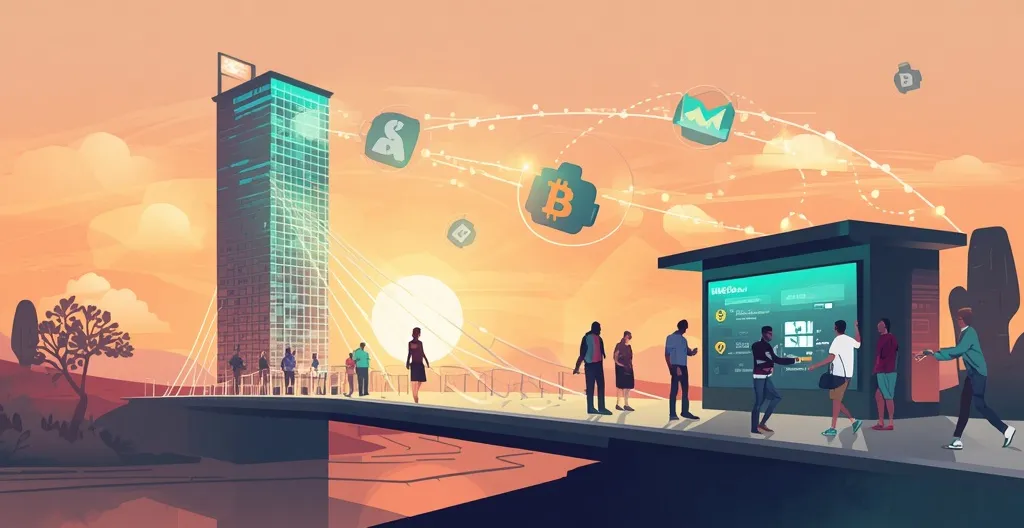
The partnership matters because it connects two things crypto often struggles to bring together: technical infrastructure and real-world distribution. Sui is positioning its network as a high-speed base layer for settlement and transfers. Paga brings local payments reach in African markets where mobile money already plays a major role.
That sounds sensible on paper. The hard part is the part that usually gets brushed aside with a glossy announcement and a few polished words about “innovation.” Financial products do not become useful because they sit on a blockchain. They become useful because people can access them, understand them, trust them, and use them without running into a wall of compliance headaches.
Tokenized real-world assets, or RWAs, are traditional assets represented on a blockchain. In practice, that could mean bonds, invoices, commodities, or other financial claims that can be transferred or managed digitally. The appeal is obvious: faster settlement, easier movement, and programmable finance.
The catch is just as obvious. Legal ownership, custody, KYC, AML, tax treatment, and jurisdictional rules do not vanish because a token now exists on-chain. Crypto loves to act like code can outrun law. Reality usually shows up with a clipboard.
According to the available information from Sui Foundation, the collaboration is aimed at exploring these tools across selected African markets rather than announcing a universal rollout. That distinction matters. Africa is not one neat market with one set of rules. It is a patchwork of payment habits, regulators, licensing regimes, and levels of mobile money adoption.
Paga’s role is a big part of why this makes sense. It is not enough to have a blockchain that can settle quickly if users have no easy way to get in and out of the system. Local payments partners matter because they bring distribution, market familiarity, and on-the-ground trust. Without that, blockchain “adoption” often amounts to little more than a group of people in a conference room congratulating themselves.
The broader backdrop also helps explain why this kind of partnership keeps popping up. Africa has long been a major testing ground for mobile-first finance, especially where traditional banking access is uneven. The World Bank’s Global Findex Database 2021 said about 57% of adults in Sub-Saharan Africa remained unbanked. That is not a small gap. It is a giant opening for alternative financial rails.
But there is no free lunch here. Mobile money and digital wallets already have deep roots in many African markets, and any tokenized product will have to compete with tools people already use. The pitch cannot just be “it’s on-chain now.” It has to be cheaper, easier, safer, or more useful. Otherwise, it is just fintech with extra steps.
Regulation is the real boss fight. Local licensing, regulatory sandboxes, compliance requirements, and user trust will all shape how fast this moves, or whether it moves at all. Different countries can have different KYC standards, tax rules, and restrictions on financial products. A pilot in one jurisdiction can look elegant while the next one gets tangled in paperwork and policy.
That is why the most important questions are still unanswered. Which assets would be tokenized first? Who would be allowed to use them? Is this meant for retail users, institutions, or both? How will KYC and AML obligations be handled? And will the product actually solve a problem people have, or just create another layer of crypto-flavored complexity?
Sui’s technical pitch gives the partnership some credibility. The network markets itself around speed, scalability, and low-friction onboarding. Grayscale Research has described Sui as using horizontal scaling and fast-path transfers, while also framing it as a strong candidate for payments-oriented use cases. That is a useful starting point, but it is not a guarantee of adoption.
Throughput is not destiny. A blockchain can be fast and still go nowhere if the ecosystem is thin, liquidity is weak, or users do not care. Crypto is full of chains that were supposedly better, faster, and smarter than the rest of the market, right up until nobody used them.
That is the real tension in this deal. On one side, tokenized RWAs are one of the most active institutional narratives in crypto right now. On the other, the path from narrative to actual utility is littered with abandoned pilots, sloppy compliance, and products that sound revolutionary until you try to use them. Real-World Assets (RWAs) explained gets at why these products are drawing so much attention in the first place, but also why the devil is in the operational details.
There is also a darker side worth keeping in view. Tokenization can be genuinely useful, but it can also be used to repackage speculative assets in a shinier wrapper. “Financial inclusion” is a wonderful phrase when it describes a real product. It is a load of nonsense when it is just marketing for a product that mainly helps insiders, traders, or middlemen dress up the same old game in a new costume.
For African markets, the upside is real if execution is disciplined. A well-built rollout could show that blockchain rails can support actual financial products in markets where mobile-first behavior is already normal. It could also help push crypto beyond its usual habit of confusing speculation with progress.
Still, no one should pretend this is settled. The announcement is an exploration, not a finished product. The hard proof points will come later: which assets launch, what access looks like, how compliance is handled, and whether users find the result useful enough to keep using it.
Until then, this is promising, but not magical. In crypto, that already puts it ahead of a lot of the nonsense.
Related momentum is showing up elsewhere too. Kraken and Franklin Templeton Expand Tokenized Assets Push is another sign that tokenization is moving from theory to real product experiments, even if the market still has plenty of snake oil to dodge.
Key takeaways
-
What did Sui Foundation and Paga announce?
They announced a partnership to explore tokenized real-world assets and blockchain-based financial tools in African markets. -
Why does Paga matter here?
Paga brings local payments reach and market familiarity, which is often the missing link between blockchain infrastructure and actual users. -
What are tokenized real-world assets?
They are traditional assets, such as bonds, invoices, or commodities, represented on a blockchain so they can be transferred or managed digitally. -
Is rollout guaranteed?
No. Licensing, compliance, local regulation, and user trust will determine whether anything launches and how quickly it happens. -
Why is Africa relevant for this kind of experiment?
Mobile money already matters across many markets, and the World Bank’s Global Findex Database 2021 found that about 57% of adults in Sub-Saharan Africa remained unbanked. -
What is the biggest risk?
That the partnership turns into another overhyped tokenization pitch that looks great in a press release and falls apart in the real world.
For a broader view of where this trend could be headed, Australia’s $16.7B Blockchain Bet shows how tokenized assets are being framed as a serious finance upgrade well beyond crypto-native circles.
And if you want the raw mechanics behind the hype cycle itself, Hashdex’s Bold 2026 Crypto Forecast is a useful reminder that forecasts are cheap, while adoption is where the bodies are buried.
For another angle on the same announcement, Sui and Paga Pilot Tokenized RWAs in African Mobile adds more context on the pilot framing and why mobile payments infrastructure is central to the plan.