“The trenches” is Solana memecoin slang for the most brutal part of on-chain trading: fast, chaotic, high-risk, and usually merciless to everyone except the bots and the lucky few.
- High speed, high failure rate
- Bots often get there first
- Most tokens die within days
- The culture is half trading, half internet gladiator theater
In Solana memecoin culture, “the trenches” means the riskiest corner of the market, where brand-new tokens launch, spike, fade, rug, revive, and get forgotten at a pace that would make a blackjack table blush.
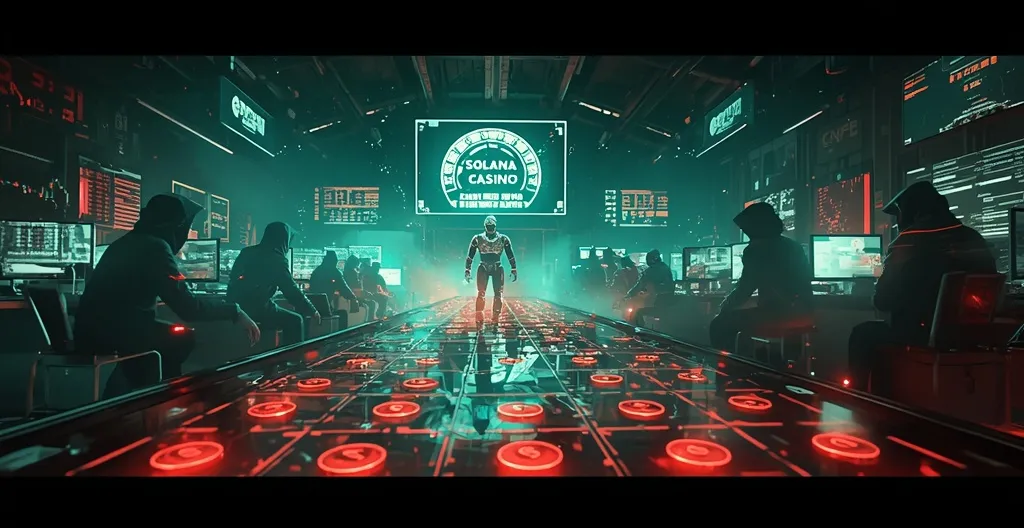
This is where traders call themselves degens or trenchers, ape into coins with little or no research, and try to catch a move before everyone else does. The dream is simple: buy early, sell before the crowd, and turn a tiny stack into a ridiculous one. The reality is uglier. For most people, the trenches look a lot more like a casino than a market.
That is not just a snarky line. It is the basic structure of the game.
Solana became the center of this culture for very plain reasons. It has low fees and fast transaction speeds, which make it cheap and practical to launch and trade tokens at insane speed. That matters when a token’s useful life may be measured in minutes, hours, or days. Cheap, fast rails are great for experimentation. They are also great for mass-producing speculative garbage.
Pump.fun sits at the heart of this ecosystem. It made launching memecoins frictionless enough that almost anyone can spin one up in seconds. On these launchpads, a token usually starts on a bonding curve, a pricing mechanism where the token gets more expensive as more buyers come in. Once enough buying happens, the token can graduate into regular trading on a decentralized exchange such as PumpSwap.
In theory, that is an elegant way to bootstrap a market. In practice, the result is often a glorious mess with better branding.
The vocabulary around the trenches is its own little dialect. To ape in means to buy fast with almost no research. To snipe means to buy immediately at launch, often with a bot. A bundle is coordinated buying across multiple wallets, usually to manufacture the appearance of demand. A rug or rug pull is the ugly end state where the creator drains liquidity or dumps tokens and the chart gets vaporized in real time.
There is also the CTO, or community takeover, where holders try to revive an abandoned coin and give it a second wind. Sometimes that works. More often it is a support group for people staring at dead bags and pretending the corpse is still warm.
The culture matters because it turns speculation into identity. Traders chase “gems, ” “alpha, ” and “bags.” They worry about being “underwater.” They hope something will “moon” or “send it.” That language is part signal, part ritual, and part cope. It gives the scene a tribal feel, which is exactly what keeps people emotionally invested long after the chart has stopped being kind.
And the speed of the market creates a nasty advantage gap. Bots and automated snipers often get to tokens before a human trader can even finish the clicks. In practice, the first advantage is frequently not conviction or research, but code and latency. That does not mean every early participant is a bot. It does mean the opening seconds are often a race with one side wearing rocket boots.
That is one reason the survival numbers are so brutal.
CoinGecko’s analysis of Pump.fun tokens from January 14, 2024 through June 18, 2026 found that 18.67 million tokens were created. Of those, 12.8 million, or 68.67%, had their final bonding-curve trade on launch day. In plain English, that means the token’s last trade on Pump.fun happened the same day it was born.
By day two, 80.37% were effectively dead. Only 850, 180 tokens, or 4.55%, were still active after 90 days. CoinGecko also notes that this may undercount tokens that moved on to other decentralized exchanges after graduating, which is fair enough, but the big picture does not change. The vast majority of launches vanish fast.
The arXiv paper Predicting the Success of New Crypto-Tokens: The Pump.fun Case reaches a similarly harsh conclusion from a technical angle. In a one-month dataset, it found 655, 770 tokens created and only 4, 338 reaching graduation, about 0.63%. The paper says graduation happens when the virtual reserve hits 115 SOL, at which point the token transitions to PumpSwap. A virtual reserve is part of the launchpad’s pricing setup, a way to structure the curve so the market can move from bootstrapping into normal trading without breaking the price continuity.
That is not a healthy survival rate by any sane standard. It is a funnel so steep it could double as a ski slope.
The point here is not that every dead token is a scam. Some are jokes that never claimed to be anything else. Some are experiments. Some are nakedly speculative plays that run out of attention and gravity at the same time. But plenty are outright garbage too, and nobody needs to pretend otherwise. In the trenches, the line between a dumb token and a malicious one can get blurry fast, because both can leave ordinary traders holding the bag.
“Fair launch” is supposed to make that cleaner. It means a token is released without a presale or insider allocation. On paper, that sounds democratic. Everyone gets the same shot. In reality, “fair launch” is not the same thing as a fair outcome. Bots, coordinated wallets, and well-prepared participants can still dominate the first moments of trading. That is a blockchain-agnostic problem in some ways, but launchpads built for speed make it even easier for the sharp elbows to win.
That is why these platforms are so controversial. Trading volume itself becomes the product. The venue gets paid when people buy, sell, chase, panic, and rotate. It does not need every token to succeed. It only needs the machine to keep moving.
CoinDesk reported on January 6, 2026 that PumpSwap hit $1.28 billion in 24-hour trading volume on January 5, with $2.98 million in fees, and $19.69 billion in 30-day volume. That is a staggering amount of churn for a segment where durable value is often an afterthought. Huge volume does not automatically mean healthy markets. Sometimes it just means a lot of people are speedrunning self-harm with extra steps.
That incentive structure matters because it helps explain why the trenches keep producing the same kind of chaos. If the system pays for activity rather than quality, it will reward hype, rotation, novelty, and constant launch velocity. That does not require a conspiracy. It is just a rotten set of incentives doing what rotten incentives do.
The memorable part of the trenches is the jackpot story. The forgotten part is the wreckage underneath it.
Survivorship bias is doing a lot of work here. People remember the token that turned into a monster winner. They do not remember the hundreds of thousands that died before lunch. The romance of life-changing gains is real. It is also rare. That gap between fantasy and odds is exactly where this whole subculture lives.
The social mythology around the trenches also sells the idea that extreme risk is a kind of badge of honor. Be early. Be savage. Be unafraid. Understand the game better than the next guy. Sometimes that is true. Sometimes someone spots a token early, manages risk well, and walks away with real money. But skill does not erase the math. A smart gambler is still a gambler when the table is tilted toward speed, extraction, and entropy.
The broader lesson is simple: the trenches are not a shortcut to wealth. They are a market layer where a few people get lucky, a few people get sharp, and a lot of people provide liquidity for the ecosystem. Same old crypto greed, just faster, louder, and decorated with meme faces.
There is still something fascinating about it, though. The culture is inventive. The coordination can be impressive. And the underlying tech, cheap, fast, programmable money rails, is real. But raw capability is not the same as good incentives. A system can be brilliantly engineered and still spit out absurdly bad outcomes.
That is the whole point of the trenches: Solana’s speed, memecoin mania, bot warfare, and human greed all colliding in one place, with the winners writing the jokes and everyone else learning what “underwater” really means.
Key questions and takeaways
-
What are the trenches?
The trenches are the fastest, riskiest part of Solana memecoin trading, where tokens launch and disappear at a brutal pace. -
Why is Solana the center of this culture?
Solana’s low fees and high throughput make rapid launch-and-trade behavior cheap, which is exactly why memecoin factories love it. -
What does “bonding curve” mean?
It is a pricing model where a token gets more expensive as more people buy it. On Pump.fun, it helps bootstrap trading before a token graduates to a normal exchange. -
What does “graduation” mean?
Graduation is when a token leaves the launchpad phase and moves into regular trading, which the arXiv paper says happens when the virtual reserve reaches 115 SOL. -
Do most memecoins survive?
No. The trenches are built on speed and churn, and CoinGecko’s data on Pump.fun tokens shows most die extremely quickly, with only a small fraction still active after 90 days. -
Are most of these tokens scams?
Not all of them. Many are simply short-lived or worthless, but scams and rug pulls are absolutely part of the ecosystem. -
Can traders make money in the trenches?
Yes, some do, but the odds are ugly, and bots, timing, and launchpad mechanics often give the house an edge. -
Why do platforms keep pushing memecoin launches?
Because trading volume itself drives revenue. If the machine gets paid on churn, it has every reason to keep feeding the churn.
Further reading
A few extra links for the memecoin tourists, trench goblins, and anyone trying to separate signal from noise.