
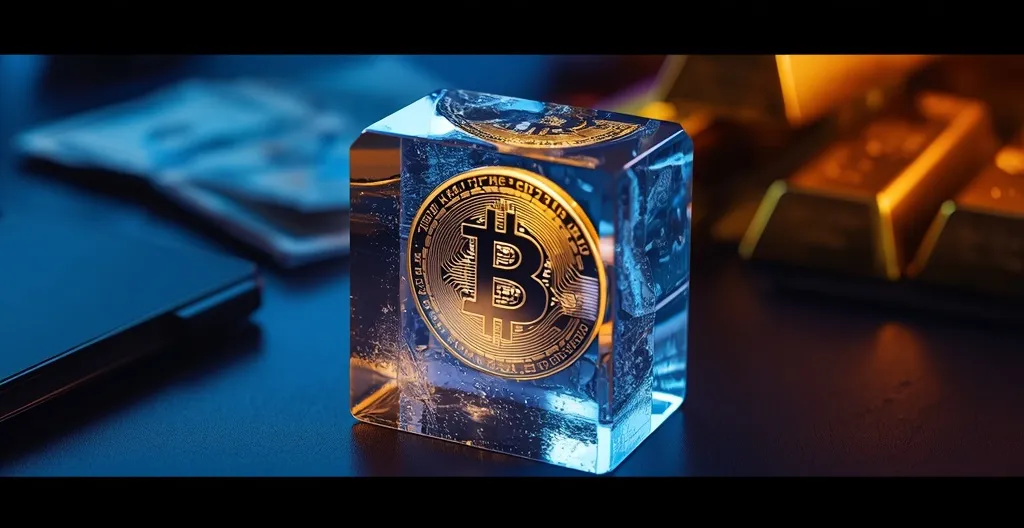
Michael Saylor’s latest Bitcoin case is simple and sharp: BTC is not a trading toy, it’s a “deep freeze” for wealth. The point is not short-term calm. The point is preserving purchasing power when cash gets diluted, gold gets cumbersome, and time does what time does best, quietly wrecking weak money.
- Big idea: Bitcoin as long-term wealth preservation, not short-term stability
- Trade-off: cash is convenient, gold is proven but clunky, BTC is portable and scarce
- Catch: Bitcoin is still too young to prove itself over a full century
The framing comes from a BeInCrypto piece by Phil Haunhorst published on August 15, 2026, which captures Saylor’s “deep freeze” metaphor for Bitcoin as a way to preserve economic value. The real question underneath it is straightforward: how much of the wealth earned today will still have meaningful purchasing power decades from now?
That’s a more serious question than “what will BTC do next week?” and, frankly, a lot more useful. Traders obsess over candles. Savers care whether their money is being slowly cooked by inflation.
Cash is handy. That’s the whole selling point. But cash sits inside a system where money supply can expand, and inflation eats away at purchasing power over time. In plain English: if your money is sitting still while the number of dollars in circulation grows, each dollar tends to buy a little less. Same paycheck, worse sandwich. The math is rude, but it is what it is.
Gold has been the old-world answer to that problem. It has a long history as a hedge against currency debasement, broad recognition, and real scarcity. It has also survived the smug certainty of many failed monetary systems. But gold is physical. That means storage, transport, and verification costs. If you want to move serious value across borders or store it at scale, gold starts to look less like elegant money and more like expensive geology.
Bitcoin’s pitch is that it keeps the scarcity and throws away the baggage. It has no physical weight. It can be transferred globally. Its issuance follows a predetermined supply schedule rather than a central bank’s policy calendar. And its supply is capped at 21 million coins.
That cap is the core of the thesis. Bitcoin’s scarcity is built into the protocol, not negotiated by committee every time politicians get nervous or the financial system starts coughing. Could Bitcoin’s monetary rules ever change? Technically, any software can be changed in theory. In practice, altering Bitcoin’s supply would require overwhelming social and economic consensus, which makes the 21 million limit one of the most durable monetary features on earth. For the mechanics behind that limit, see what happens to Bitcoin after all 21 million are mined.
That’s why Saylor’s metaphor works: Bitcoin is supposed to “freeze” value, not by making price movements disappear, but by resisting the kind of monetary dilution that erodes savings over time. In other words, it is meant to preserve the economic energy created by work and productivity, or, less poetically, to keep saved money from being quietly debased. That’s basically the logic behind a store of value, even if Bitcoin fans like to make it sound more dramatic than a finance textbook with caffeine.
Still, the honest version of this argument has to include the uncomfortable part: Bitcoin is not a stable asset in the short term. BTC was trading near $63, 000 in the referenced snapshot, but that number is just a snapshot, not a promise. Bitcoin can move violently, and anyone pretending otherwise is either clueless or selling something.
That volatility is the biggest knock against the store-of-value narrative. A store of value should hold value, not send holders on an emotional cross-country road trip every few months. If you need money for next week’s rent, Bitcoin is not a calm little savings account. It never claimed to be.
And that’s the key distinction. Saylor’s argument is about long-term value preservation, not day-to-day usability. Bitcoin’s supporters see it as a way to keep the purchasing power of labor over long stretches of time, especially when compared with fiat money that can be expanded and gold that can be awkward to move and verify.
But there’s another reality check that matters just as much as the upside: Bitcoin has not existed long enough to prove it can preserve purchasing power across a full century. That’s not a smear. It’s just chronology. Less than two decades of history is interesting, but it is not a 100-year track record. Anyone claiming otherwise is doing marketing, not analysis. Saylor may be bullish, but the market has not signed a lifetime lease yet, and his own conviction has been covered in pieces like “No doubt in my mind Bitcoin will be bigger than gold within a decade”, which is the kind of statement that sounds brave right up until reality brings receipts.
That also explains why the comparison between Bitcoin, gold, and cash matters so much. They are built for different jobs:
- Cash is for convenience and payments, but it is exposed to inflation.
- Gold is for preserving value physically, but it comes with friction.
- Bitcoin is for preserving value digitally, with portability and programmed scarcity.
That framing is clean, but it shouldn’t be oversold. Fiat money is not “bad” because it exists. It is useful because it is liquid, easy to measure in, and practical for wages, taxes, and day-to-day commerce. Monetary flexibility can also help governments and central banks respond to shocks and keep the system moving. The problem is that what makes fiat useful for the economy can also make it hostile to long-term savers.
Bitcoin’s edge is that it tries to separate those two functions. Spend with convenient money if you need to. Save in something scarcer if you want to resist dilution. That idea is powerful, especially for people who distrust central issuers, value self-custody, or simply want an asset that can cross borders without asking permission. It is also why comparisons with gold keep coming up, including takes like Peter Schiff Slams Bitcoin as Bearish Against Gold in 2025 and debates over whether Bitcoin and crypto seize the safe-haven crown when the metal crowd gets nervous.
But the risks are not imaginary. Regulation can change the game. Custody mistakes can wipe people out. Exchanges can fail. Keys can be lost. Markets can spend years proving that “digital scarcity” still trades like a risk asset when fear hits. None of that kills the thesis, but none of it is a footnote either.
The cleanest reading of Saylor’s position is not blind faith. It is a long-horizon bet: Bitcoin may become the strongest digital tool for preserving wealth across generations, but it has not yet earned a century of trust. That leaves room for optimism without pretending the debate is settled. If you want the more polished pitch, there’s also the familiar Bitcoin as digital gold framing, useful, though a little too neat for a market that still has a habit of punching people in the mouth.
Key takeaways
- What does Saylor mean by “deep freeze”?
He means Bitcoin is better understood as a long-term wealth-preservation asset than a short-term stability tool. The goal is to protect purchasing power over years and decades. - Why compare Bitcoin with cash and gold?
Cash is easy to use but loses value to inflation. Gold has a strong historical record but is cumbersome. Bitcoin tries to combine scarcity with digital portability. - Does Bitcoin’s fixed supply make it a store of value?
It helps a lot, but supply cap alone is not enough. Demand, adoption, regulation, custody, and trust all shape whether BTC actually holds value over time. - Has Bitcoin proven itself over a century?
No. Bitcoin has not existed long enough to prove century-scale purchasing-power preservation, which is the fair skeptical response to any grand claims. - Is Bitcoin a safe short-term savings asset?
Not really. Bitcoin is volatile, so its store-of-value case is aimed at long horizons, not near-term stability.
The bottom line is blunt: Bitcoin is not trying to be cash, and it is not trying to be gold with a shinier website. It is trying to be a scarce digital asset that resists dilution better than fiat and moves more easily than metal. Whether it ultimately earns that role is still unresolved, but at least that is the right debate.
Further reading
For a sharper look at Saylor’s “money as energy” thesis, this piece is worth a skim.