
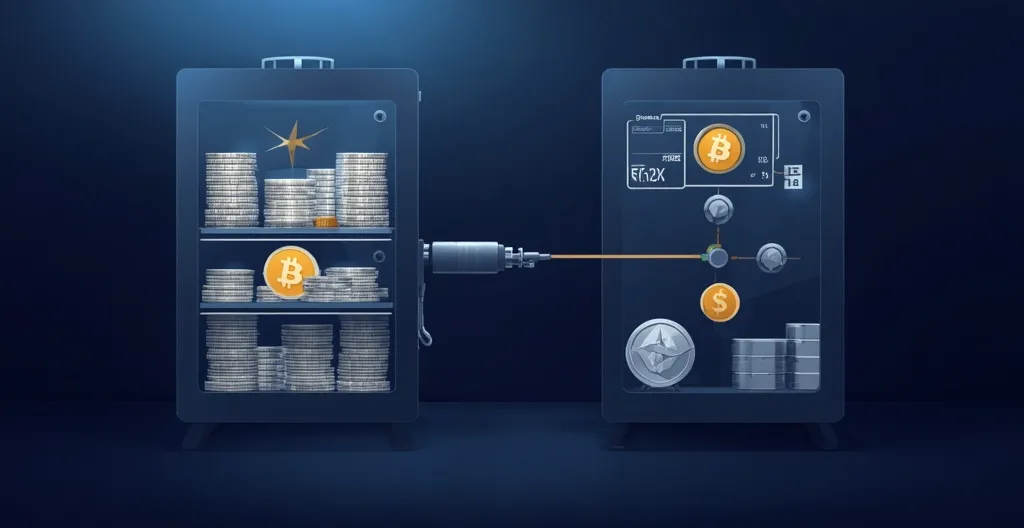
Kraken and Maple are trying to make crypto lending look a lot more like structured credit and a lot less like the loose, failure-prone mess that wrecked so much of the market in 2022.
- June 24 launch of an institutional warehouse financing facility
- USDC-funded SPV built to isolate risk
- Kraken affiliates originate, sell, and service the loans
- Maple provides senior financing
- Bitcoin and Ether are the collateral, held by Kraken Financial
The two firms announced an institutional crypto lending facility on June 24, built through a bankruptcy-remote special purpose vehicle, or SPV. In plain English, the loans sit inside a separate legal entity, so trouble in one part of the structure is less likely to infect the rest. That does not wipe out the risk. It just keeps the whole thing from becoming one giant shared panic attack.
The facility is funded in USDC, the dollar-pegged stablecoin that has become a practical settlement asset in crypto markets. Kraken affiliates originate, sell, and service the loans, while Maple provides senior financing. Kraken also keeps an economic interest in the setup, which means it still has money on the line instead of just taking a fee and walking away.
Bitcoin and Ether serve as collateral, with Kraken Financial, Kraken’s Wyoming-chartered Special Purpose Depository Institution in Wyoming, holding those assets. Zaria is the independent SPV administrator. There are a lot of moving parts here, but that is the point. The structure is meant to separate lending, collateral custody, and administration in a way institutions can actually model instead of squinting at and hoping for the best.
Neither Kraken nor Maple disclosed the size of the financing arrangement or its commercial terms. That matters. In crypto, a polished structure can sometimes be used to dress up a small number in a very expensive suit. The architecture here is real. The scale is still hidden behind the curtain.
Warehouse financing is a familiar tool in traditional credit markets. It gives a lender or originator working capital to make loans before those loans are sold, refinanced, or otherwise financed at scale. That lets Kraken expand its over-the-counter lending business without having to fund every loan directly from its own balance sheet.
That kind of structure is not flashy, but it is the sort of plumbing serious capital likes. It is also the sort of plumbing crypto lending badly needed after the industry learned, the hard way, what happens when leverage, weak controls, and sloppy collateral management are allowed to pass for a lending business.
The wreckage left by Celsius and BlockFi still hangs over this sector. Those failures showed how fast opaque counterparty risk, liquidity mismatch, and poor collateral discipline can turn a lending book into a crater. “Trust me, bro” is not a credit framework, no matter how many tokenized slides you wrap it in.
This Kraken-Maple setup is clearly trying to answer that history with a more disciplined model. Bankruptcy remoteness helps isolate the financing vehicle from the parent company’s problems. Senior financing gives Maple priority in the capital stack. Independent administration adds another layer of oversight. And using Bitcoin and Ether as collateral keeps the exposure tied to the most liquid assets in crypto.
That said, collateral quality is only part of the equation. Bitcoin and Ether are better than obscure tokens with thin liquidity and no real market depth, but they are still volatile assets. If markets turn nasty, loan-to-value management, liquidation mechanics, and custody discipline will matter far more than the marketing language around “structured” finance.
A clean legal wrapper does not make bad loans good. If collateral falls fast enough, you still get forced sales, liquidation slippage, and all the ugly little mechanics that show up when risk meets gravity. Finance loves elegant diagrams right up until the first stress test.
The bigger signal is that crypto credit is moving toward more institutional, more structured models. Data cited from RWA.xyz shows tokenized credit has grown to more than $6.2 billion in distributed value, up from roughly $1.87 billion a year earlier. Maple is said to have about $1.4 billion in tokenized credit assets. Bernstein has also estimated tokenized credit could be a $4 trillion addressable market.
Those figures point to real momentum, but they need to be read carefully. “Distributed value” is not necessarily the same thing as active loan principal, and “addressable market” is analyst-speak for a big theoretical pool of business, not a guaranteed revenue stream. Useful numbers, yes. Gospel, no.
Still, the direction is hard to miss. Tokenized credit is moving from niche experiment toward something that looks increasingly like capital-markets infrastructure. The appeal is obvious: onchain records, faster settlement, programmable controls, and structures that can be inspected and serviced more cleanly than the old private-lending chaos.
That trend is not limited to Kraken and Maple. Ripple has a $200 million credit facility from Neuberger Berman. Other firms are pushing stablecoin and digital asset programs for U.S. credit unions, Bitcoin-backed credit products for European investors, and fixed-rate, fixed-term onchain lending protocols. The market is clearly testing how much of traditional credit can be rebuilt with blockchain rails.
At the same time, DeFi still has a habit of reminding everyone that code is not the same thing as safety. Radiant Capital’s $50 million exploit in 2024 is a fresh reminder that lending systems can fail through technical weaknesses as easily as through bad underwriting. Different failure mode, same end result: somebody eats the loss.
For Bitcoin, the more important takeaway is that it is increasingly being treated as collateral rather than just speculation fodder. That is a meaningful shift. A hard-money asset that can sit inside institutional lending structures has a different role than one being chased around by leverage and memes. Ether keeps its place too, especially where liquidity and market depth matter.
Altcoins may still fill niches that Bitcoin does not, and should not, try to serve. But when institutions want recognizable collateral and deep markets, they tend to reach for the biggest and most liquid assets first. Shocking, I know: the people handling real money usually prefer not to build the house out of Jenga blocks.
What’s the real takeaway? Crypto lending is trying to grow up. The sector’s post-2022 rebound is being built with more structure, more custody discipline, and more explicit risk layering. That is a healthy development, but it is not a magic shield. Better plumbing reduces contagion; it does not repeal credit risk.
Key questions and takeaways
-
What did Kraken and Maple launch?
An institutional warehouse financing facility for crypto-backed loans, structured through a bankruptcy-remote SPV and funded in USDC. -
Who does what in the setup?
Kraken affiliates originate, sell, and service the loans. Maple provides senior financing, Kraken retains an economic interest, Kraken Financial holds the collateral, and Zaria administers the SPV. -
Why use a bankruptcy-remote SPV?
It helps isolate the lending vehicle from the parent company’s problems and reduces contagion risk if one part of the structure gets hit. -
Why does USDC matter here?
USDC gives the facility a dollar-like funding asset that is easier for institutions to settle and manage than a volatile crypto asset. -
Why are Bitcoin and Ether the collateral?
They are the most liquid and widely recognized crypto assets, which makes them more usable for institutional lending than thinner, riskier tokens. -
Does this eliminate crypto lending risk?
No. It improves structure and risk isolation, but collateral volatility, liquidity shocks, custody problems, and bad underwriting can still blow up a loan book. -
Why is this important for Bitcoin?
It shows Bitcoin is increasingly being used as institutional collateral, not just as a speculative asset or a trading vehicle.
The question now is whether this becomes a repeatable model. If more originators adopt structured, overcollateralized onchain credit with proper custody and servicing, crypto lending could become far more durable than the wreckage that came before. If not, this may just be another polished wrapper on the same old credit risk.
Further reading
A few useful references on the financing structure and the players behind it: