
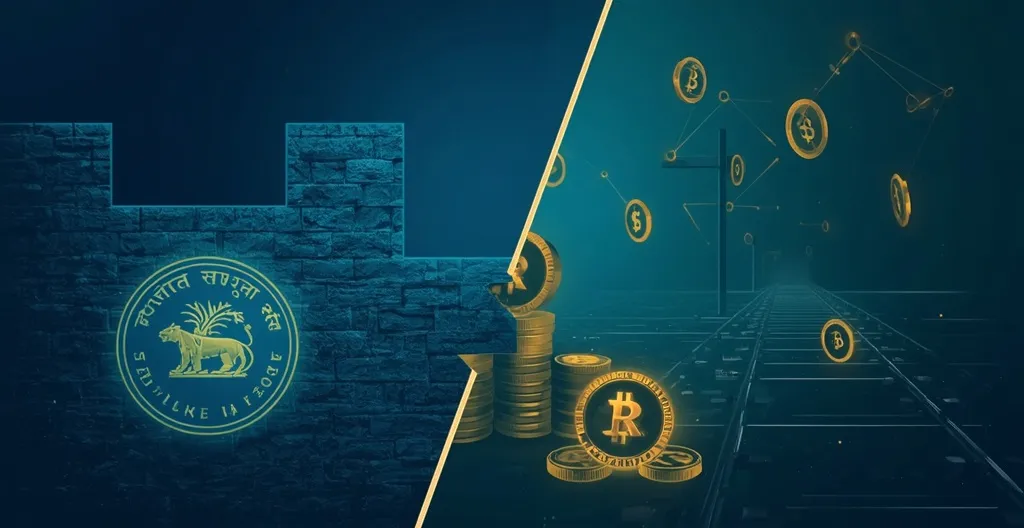
India’s RBI Draws a Hard Line on Crypto as the U.S. and Europe Keep Folding It Into Finance
India’s central bank is making its stance clear: private crypto and stablecoins should stay out of the banking system. The U.S. and Europe are heading the other way, toward clearer rules, licensing, ETFs, and tokenized market infrastructure that pull digital assets closer to mainstream finance.
- RBI wants banks kept apart from crypto
- Stablecoins are the real red line
- U.S. and Europe are normalizing digital assets
- Tokenization is growing, but so are security risks
The Reserve Bank of India’s basic argument is simple: regulated banks and private crypto assets should not mix. In the RBI’s view, once speculative tokens or privately issued stablecoins start looking and acting like ordinary financial products, people may mistake them for safe money-like instruments. That false comfort is exactly what central banks worry about, because when risk spills into the regulated system, everyone ends up holding the bag.
The sharpest concern is stablecoins. According to the RBI’s Deputy Governor T Rabi Sankar in a BIS-hosted keynote, stablecoins are not just another crypto experiment. They are a direct challenge to financial stability, monetary sovereignty, and monetary policy transmission, the channels through which a central bank influences credit, liquidity, borrowing, spending, and inflation.
“Stablecoins can create hundreds, or more, of currencies in an economy and make it inherently unstable.”
That line gets to the heart of the RBI’s position. If private tokens start working like money at scale, the central bank loses control over the unit of account and the payment rails that matter most. In plain English: the RBI does not want a shadow money system growing next to the rupee.
The RBI’s answer is a central bank digital currency, or CBDC. A CBDC is a digital form of state-issued money. Central banks like the idea because it keeps control with the sovereign, keeps payments inside the official system, and avoids handing monetary infrastructure to private companies that can change the rules whenever it suits them. Critics hear “CBDC” and picture a programmable state ledger with a nicer haircut. Fair enough. The trade-off is real.
This is not a minor philosophical disagreement. It is a fight over who gets to define money in a digital economy. The RBI’s view is that money needs to stay singular and state-backed. Private crypto, in its eyes, is speculative at best and destabilizing at worst. Stablecoins are the sharper threat because they do not just sit on exchanges, they aim directly at payments.
That puts India on one side of a widening global split. The U.S. and Europe are not exactly rolling out the red carpet for every token with a website and a Telegram group, but they are clearly building more formal lanes for crypto to operate inside regulated finance.
In the U.S., Bloomberg reported that the Senate is expected to release the final text of the “Bitcoin Clarity” bill within days, possibly during the Independence Day holiday period, according to journalist Pete Rizzo. The exact text was not public in the material at hand, but the direction is obvious enough: Washington is still trying to build a clearer market structure instead of leaving the industry to guess which agency is in charge this week.
Market data also showed a partial rebound in institutional appetite. On July 2 ET, U.S.-listed spot Bitcoin ETFs recorded $222 million in net inflows, ending 10 consecutive trading days of net outflows, according to data cited by Wu Blockchain. Spot Ethereum ETFs brought in $29.08 million on the same day. Bitcoin was trading above $62, 000, up 1.33% over 24 hours to around $62, 015 on OKX pricing, according to ODaily.
Spot ETF flows matter because they give a clean signal of demand for regulated exposure. They do not magically prove a new bull phase, and they certainly do not make every price prediction flyer suddenly wise. But they do show that institutional money is still willing to show up when the structure is simple, legal, and boring enough for compliance teams to stop throwing furniture.
Europe is moving in its own direction, but it is still a direction that brings crypto closer to the financial system rather than pushing it away. PANews reported that Stripe’s stablecoin payments platform Bridge secured a MiCA-aligned crypto-asset service provider license and an electronic money institution license in Luxembourg. Those authorizations are valid across the European Union’s 27 member states.
MiCA, the EU’s Markets in Crypto-Assets framework, is designed to create a passportable regime across the bloc. In practice, that means a firm licensed in one EU jurisdiction can expand more easily across the region, instead of fighting a different rulebook in every country. For Bridge, that opens the door to broader stablecoin services for European customers and gives enterprises a more compliant way to move between stablecoins and euros.
That is a very different model from the RBI’s. India wants a ring-fenced financial system. Europe wants licensed crypto services that can plug into the existing payment stack. One side sees private digital money as a threat to contain. The other sees it as infrastructure to supervise.
The U.S. is also pushing harder into tokenization, which is the practice of representing a traditional asset on a blockchain. SEC Chair Paul Atkins, according to Watcher.Guru, said the agency is modernizing rules to bring financial markets “on-chain”. That phrase gets abused a lot, but the underlying trend is real: capital markets firms are testing whether stocks, funds, and settlement workflows can live on blockchain rails without collapsing into chaos.
Securitize is one of the companies trying to turn that idea into something less theoretical. It launched a tokenized version of its SECZ stock on Solana and Avalanche while the shares began trading on the New York Stock Exchange. According to the supplied figures, SECZ opened at $12.45, hit an intraday high of $13.70, and closed at $12.30.
Securitize President Bret Redfearn also said the firm is discussing tokenized IPO allocation with capital markets teams at major banks including JPMorgan Chase, and suggested tangible progress could emerge within three to 12 months. If that timeline proves even roughly right, it would be another sign that tokenization is shifting from pitch decks to actual market plumbing.
Tokenization is attractive for obvious reasons. It can reduce settlement friction, enable fractional ownership, and make transfer and recordkeeping more efficient. But it also comes with a pile of old-fashioned headaches: custody, shareholder rights, compliance, transfer restrictions, legal finality, and whether the blockchain version actually maps cleanly to the real-world asset it claims to represent. The demo is easy. The legal and operational mess is where the grown-up work begins.
Solana is emerging as one of the main test beds for that kind of activity. SolanaFloor reported that the chain’s total real-world asset value reached an all-time high of $3.62 billion, with more than $540 million of RWA value flowing onto the network over the past seven days. That points to real momentum, but it should still be read with a skeptical eye. RWA totals can move fast, and a few large issuances can make a chart look far more broadly adopted than it really is.
There is also still money sloshing around the crypto infrastructure layer. PANews, citing Axios, reported that Mesh is raising a new round led by Binance that could value the company at up to $2 billion. If that figure holds, it would show investors still have plenty of appetite for crypto payments rails, not just trading venues and meme-fueled nonsense. The industry keeps trying to grow up. The market keeps handing it a credit card and a haircut.
But the dark side is never far away. CertiK Alert reported suspicious transactions on the decentralized privacy protocol Hinkal that led to the theft of about 800, 000 USDC. CertiK said an externally owned account completed a “Proofless Deposit” before carrying out multiple transactions that drained funds from the protocol’s contracts.
That is the recurring problem with DeFi. The promise is open, permissionless finance. The reality is that one bad contract path, one flaw in the transaction flow, or one exploitable design choice can turn a protocol into a cautionary tale before the coffee gets cold. Permissionless systems are powerful. They are also an enormous attack surface, and the thieves know it.
So the global picture is getting sharper, even if it is still messy. India’s RBI wants private crypto and stablecoins kept at arm’s length from banks and payments. The U.S. is inching toward clearer crypto market rules and more institutional access. Europe is building a licensing framework that makes compliant digital-asset services easier to scale across borders.
Stablecoins sit at the center of the fight because they are the bridge between crypto and real-world money. They are useful, fast, and increasingly embedded in payments. They are also exactly the kind of instrument that makes central bankers nervous, because they can look like money, move like money, and compete with money, without being sovereign money. The BIS’s take on stablecoins makes that tension hard to ignore.
Bitcoin remains the cleanest decentralized monetary asset in the field. But the broader battle right now is not just about BTC. It is about whether private digital money gets contained, supervised, or absorbed into the financial system at scale. That is the fault line running through today’s crypto regulation debate.
Key questions and takeaways
-
Why is the RBI so hostile to stablecoins?
Because it sees them as a direct threat to monetary sovereignty, monetary policy transmission, and financial stability. The RBI does not want private money competing with the rupee inside payments and banking. See also the RBI’s broader concerns in its warnings on digital assets and financial stability. -
Is India banning all crypto?
Not necessarily based on the information here. The RBI is pushing a highly restrictive stance and sees a ban as a key option, but that is not the same as an enacted nationwide ban. For more context, see India’s RBI Urges Crypto Ban as Global Regulatory Divide. -
What is the U.S. doing differently?
The U.S. is moving toward more defined market structure, spot ETF access, and tokenization pilots. That does not mean regulators are cheering for crypto, it means the industry is being folded into a clearer rule framework. Gensler’s earlier position on the approval of spot Bitcoin exchange-traded products shows how contentious that path has been. -
Why do spot ETF inflows matter?
They show demand for regulated exposure to Bitcoin and Ethereum. Inflows are not a perfect read on price direction, but they do tell you when institutional money is willing to come back in. -
Why is tokenization getting so much attention?
Because it could make traditional assets easier to settle, transfer, and fractionalize on blockchain rails. The upside is real, but the legal, custody, and compliance hurdles are still the hard part. The ECB’s digital euro work shows central banks are thinking along similar lines, just with a state-issued version of the same machinery. -
What is the biggest risk in DeFi right now?
Security. Hinkal’s reported loss shows that one exploit path can drain serious money fast. DeFi is still innovative, but it remains brutally vulnerable when the code or transaction logic is flawed. It is also fair to say crypto has a habit of recreating the middlemen it swore it would kill, just with more logos and less accountability, as noted in Crypto Recreated the Middlemen Bitcoin Promised to Remove.
The real split in crypto regulation is not hype versus no hype. It is containment versus integration. India wants a hard wall. The U.S. and Europe are building regulated on-ramps. Stablecoins, tokenization, and DeFi security are where that fight is playing out in the real world, with real money on the line.