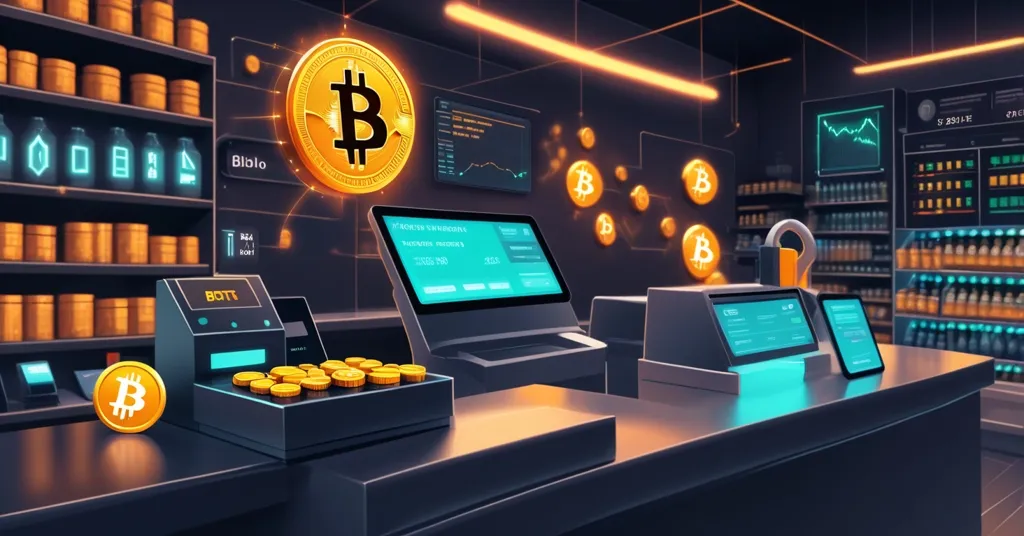
GoMining launches Bitcoin commerce tool that cuts out fiat has launched GoBTC Pay, a Bitcoin payment infrastructure stack that lets merchants accept BTC directly on-chain without converting it to fiat first.
- GoBTC Pay Gen1 SDK and API is now live for merchants, wallet providers, and partners.
- No fiat conversion: settlement happens on the Bitcoin network.
- 0.2% merchant fee, split between wallet providers and miners.
- Limited rollout starts with up to 10 merchants and partners.
- Bitcoin-native infrastructure includes a private 15 EH/s mempool setup and Stratum V2.
It’s a clear bet on Bitcoin as money, not just a vault asset. GoMining says the platform is designed to make Bitcoin payments “easier for merchants and wallet providers to support in everyday commercial transactions,” while processing payments “directly on Bitcoin while allowing users to retain control of their assets throughout the transaction flow.” In plain English: the company wants merchants to take BTC at checkout and settle on-chain, with fewer moving parts and fewer middlemen.
What GoBTC Pay actually is
GoBTC Pay Gen1 SDK and API is a toolkit that merchants and ecosystem partners can integrate into payment flows. SDK stands for software development kit, which is basically a package of tools developers use to plug a service into apps, checkout pages, or other software. An API, or application programming interface, lets systems talk to each other without everyone building custom plumbing from scratch.
For merchants, the big hook is simple: accept Bitcoin directly and avoid immediate conversion into dollars, euros, or whatever fiat currency is doing the slow-motion inflation dance this week. GoMining says that means transactions settle on the Bitcoin network itself, not through a card network or a crypto gateway that routes payments through fiat rails behind the scenes.
That matters because “no fiat conversion” is not just a slogan. It means a merchant can, at least in theory, hold BTC through the settlement process instead of cashing out instantly. Whether that is a feature or a headache depends on the business. A Bitcoin treasury-friendly company may love it. A restaurant with thin margins and payroll due on Friday may not.
The fee pitch: cheap, lean, and very much trying to make card networks blush
GoMining is charging a 0.2% merchant fee, and it says that fee is split between wallet providers and miners. That is aggressively low by payments standards and is clearly meant to stand out against crypto payment gateways, which often charge roughly 0.5% to 1%, and traditional card processing, where merchant costs often run around 1.5% to 3.5%.
The company is also leaning on a familiar Bitcoin argument: if miners already earn block rewards and transaction fees, why shouldn’t they be part of the payments infrastructure too? GoMining says miners are “well placed to operate payment protocols directly on the Bitcoin mainnet.” The logic isn’t absurd. Miners already secure the network and process transactions, so extending that role into merchant settlement feels natural from a Bitcoin-native perspective.
But low fees alone do not make a payment system useful. Merchants care about the whole mess: customer adoption, ease of integration, refunds, accounting, tax treatment, volatility exposure, and whether the payment method adds more friction than it removes. Cheap is great. Useful is better. Cheap and useful is the actual prize.
Why the rollout starts small
The launch begins with up to 10 merchants and partners. That’s a sensible move. Bitcoin commerce has a long history of sounding revolutionary in pitch decks and then crashing into reality when actual businesses ask annoying questions like: How fast does settlement happen? Who handles disputes? What if BTC moves 8% before the books close?
GoMining estimates settlement takes around 12 hours on average. That may be acceptable for some online merchants, invoice-based businesses, or larger transactions where immediate finality is not critical. It is far less appealing for low-value retail purchases where speed and convenience matter more than ideology. Buying a coffee and waiting half a day for settlement is not exactly a killer user experience.
The limited rollout also suggests GoMining knows this is a proof-of-concept as much as a product launch. Smart. Bitcoin payment infrastructure is not judged by hype; it gets judged by whether merchants keep using it after the novelty wears off.
Why miners are talking payments at all
GoMining says the platform uses a private 15 EH/s mempool infrastructure and Stratum V2 technology. For readers who do not spend their weekends spelunking through mining protocols, EH/s means exahashes per second, a measure of Bitcoin mining power. The mempool is the waiting room for unconfirmed Bitcoin transactions before miners pick them up. Stratum V2 is a newer mining protocol that improves efficiency and gives miners more control over transaction selection.
In other words, GoMining is not just saying it can accept BTC. It is saying it has enough infrastructure muscle to help run the payments layer around Bitcoin itself.
That is an interesting thesis. If miners are already the ones securing block production and collecting transaction fees, they may be well positioned to offer adjacent services like merchant settlement, routing, and transaction prioritization. There is a logic to this. Bitcoin miners are not merely energy-hungry block factories; they are the network’s native infrastructure operators.
Still, there’s a gap between “technically elegant” and “merchant wants to deal with it.” A mining company can build a Bitcoin-native payments rail, but that does not magically solve customer-side adoption. Merchants do not get paid in ethos points. They get paid in revenue, and revenue tends to prefer systems that are fast, familiar, and boring.
Bitcoin commerce versus the reality of payments
GoMining’s launch lands in the middle of a long-running debate: should Bitcoin primarily be treated as digital gold, or should it function as everyday money?
The purist answer is that Bitcoin was always meant to be used as a peer-to-peer payment system. GoMining leans into that framing, pointing out that Bitcoin was originally created to transfer value between users rather than sit idle in wallets. That’s a fair reminder that “hodl” was never the whole story.
The practical answer is harsher. Bitcoin payments have historically struggled with speed, usability, and cost compared with card rails and some newer blockchain payment systems. Even when fees are low, the user experience can be clunky. Even when settlement is on-chain, businesses still have to manage volatility, reconciliation, and the occasional accounting migraine.
For some merchants, direct BTC acceptance makes sense. Think high-ticket e-commerce, global sellers, privacy-conscious users, or businesses already holding Bitcoin on balance sheet. For others, it’s a niche feature customers may rarely use. If your checkout flow becomes a museum exhibit for crypto ideology, you may have built a shrine instead of a payment method.
What makes this different from typical crypto payment gateways
Most crypto payment gateways exist to help merchants accept crypto and then quietly convert it to fiat. That protects businesses from volatility and keeps bookkeeping simple, but it also means crypto is often just a temporary wrapper around the same old fiat settlement system.
GoMining is pitching something more Bitcoin-native: direct settlement on Bitcoin, no fiat conversion, and a fee structure that leaves “less room for intermediaries.” That’s the core distinction. The company is not trying to be a middleman for legacy rails. It is trying to be part of the rail itself.
That makes the product more aligned with self-custody and decentralization, which will resonate with bitcoiners who are tired of crypto payment systems that act like banks wearing a leather jacket. But it also makes the model harder. Removing intermediaries is great until you realize some of those intermediaries were doing unglamorous but important work like customer support, risk management, and smoothing out the rough edges.
The backstory and the people behind it
GoMining was founded in 2021 and operates BTC mining across multiple global data centers. The company says it is backed by Bitscale Capital and uses Bitmain infrastructure and BitGo for institutional custody. Its advisory board includes Tal Cohen and Victor Orlovski, with Cohen joining in June 2025.
Cohen previously served as CEO of Kraken US and also worked at McKinsey and Google. That kind of roster signals an attempt to blend crypto-native experience with mainstream operational credibility. Sometimes that combination helps a project ship something serious. Sometimes it just means the deck looks better to investors. Reality usually decides which one it is.
GoMining’s broader positioning is also telling. This is not a company pretending Bitcoin is only a collectible. It is pushing BTC commerce, Bitcoin payment infrastructure, and merchant Bitcoin payments as a real use case. That aligns with the broader e/acc-friendly view that useful technology should be deployed, not worshipped from a distance.
The catch: adoption is brutal, and merchants are not ideological volunteers
Here’s the part where the shiny narrative meets the annoying facts.
Merchants do not adopt payment systems because they are elegant. They adopt them because customers use them, margins improve, and support overhead stays manageable. Bitcoin settlement can be attractive, but it still has to survive contact with real-world commerce.
Volatility is the obvious issue. If a merchant accepts BTC directly and does not immediately convert it, the value of that payment can swing before the funds are spent. Refunds become trickier too. Tax treatment and accounting get more complex. Some businesses will happily deal with that. Many will not.
Then there is the customer side. Plenty of people like Bitcoin as an asset. Fewer people want to use it to buy everyday goods if a card tap is faster and a stablecoin or Lightning payment is simpler. That does not make GoBTC Pay pointless. It just means the product is targeting a narrower merchant set than “Bitcoin payments for everyone” would imply.
There is also the uncomfortable truth that blockchain infrastructure does not automatically create demand. A clever SDK, a low fee, and a mining-backed settlement rail are useful ingredients. They are not a guarantee. Adoption has a way of humbling even the most confident crypto launch.
Key questions and takeaways
-
What did GoMining launch?
GoMining launched GoBTC Pay Gen1 SDK and API, a Bitcoin payment infrastructure stack for merchants, wallet providers, and partners. -
Does it convert Bitcoin into fiat?
No. Payments settle directly on the Bitcoin network without first converting into fiat. -
What does it cost merchants?
GoMining says the fee is 0.2% per transaction, split between wallet providers and miners. -
How fast is settlement?
The company estimates settlement takes around 12 hours on average. -
Why does this matter for Bitcoin?
It pushes Bitcoin beyond “store of value” branding and back toward its original payments use case. -
Can it challenge card networks?
It can pressure payment fees and offer a Bitcoin-native alternative, but merchant adoption and customer demand will decide whether it scales. -
What’s the biggest obstacle?
Usability. If Bitcoin payments are not faster, simpler, or more useful than existing options, merchants will treat them as a novelty instead of a default rail.
GoMining deserves credit for taking the Bitcoin-as-money thesis seriously instead of just repeating it like a slogan. GoBTC Pay is a real attempt to build merchant Bitcoin payments on Bitcoin infrastructure, with direct on-chain settlement, a low fee model, and a structure that gives miners and wallet providers a role in the payment flow.
That’s promising. It’s also not magic. Bitcoin has always had the potential to be a settlement layer for commerce, but potential is cheap and execution is hard. If GoMining can make the stack reliable enough, simple enough, and useful enough for merchants to actually adopt, it could carve out a meaningful niche. If not, it becomes another reminder that being right about decentralization does not exempt anyone from the ruthless economics of payments.