
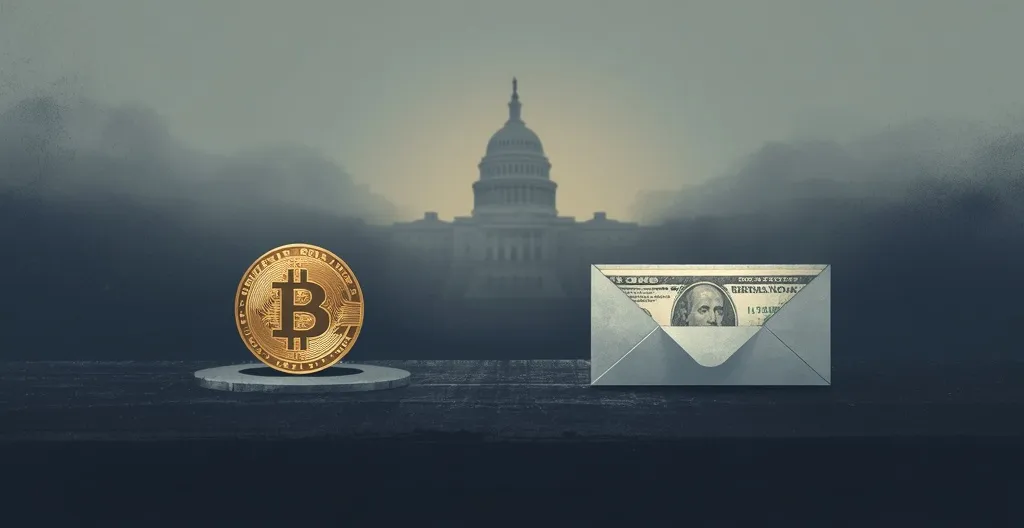
A reported $5, 000 payment to each adult, contingent on Republicans sweeping Congress, could send more money into crypto, DWF Labs managing partner Andrei Grachev reportedly argued. But neither the payment plan nor its potential market impact has been independently established. A political scenario is not a trading signal.
- KuCoin News Flash attributes the forecast to Grachev, citing remarks to MarsBit.
- The reported condition is Republican control of both chambers in the 2026 midterms.
- The $5, 000 payment and $1.2 trillion estimate lack primary-source support in the reporting reviewed.
- Even if payments happened, there is no evidence showing how much recipients would invest in crypto.
What is being claimed?
KuCoin News Flash says Grachev discussed a possible crypto rally with MarsBit, tying it to a reported proposal for a $5, 000 payment to each adult if Republicans win control of both the House and Senate. KuCoin’s English summary estimates the proposal would cost $1.2 trillion in total.
The claim is secondhand. The materials supporting it do not include the original MarsBit report or a direct statement from Grachev. They also provide no Trump statement, campaign document, bill or government source confirming the payment. The $1.2 trillion figure comes without eligibility rules, a funding plan or a cost calculation. Neither the payment nor its price tag is confirmed policy.
One distinction matters: the 2026 midterms decide control of Congress. Trump is not running for president in that election. The reported scenario is a Republican win in both chambers.
Could a payment spark a crypto rally?
There is a plausible path from stimulus to higher asset prices. Recipients who have money left after covering expenses might invest some of it, potentially adding demand for Bitcoin or other cryptocurrencies. Grachev reportedly compared the possible rally with 2021.
Still, the leap from cash payments to a bull market is speculation. The report offers no survey or model estimating how many recipients would buy crypto, how much they might invest or which assets could benefit. People may use the money for rent, food and other essentials, pay down debt or save it. Those are ordinary uses of cash, not a failure of the market thesis. They simply make the outcome less predictable.
The broader economic effects could cut either way. A large public outlay might support consumer spending, while also intensifying debate over government borrowing, inflation and interest rates. Those factors can shape appetite for riskier assets. Markets might also move on expectations about the proposal’s political prospects, well before any money reaches households.
Even if crypto prices rose alongside a payment program, timing alone would not establish cause and effect. Regulation, monetary policy, investor positioning and broader market conditions could all play a role. The forecast does not define what counts as a “bull market, ” how long one would last or whether the comparison refers to Bitcoin, altcoins or the market as a whole.
Election patterns are not a reliable forecast
Past Bitcoin performance around U.S. midterms does not settle the question. Reported post-election declines lack clearly defined measurement windows, and a handful of election cycles cannot show that elections caused price moves. Those figures also concern Bitcoin, not the entire crypto market.
Political events can shape expectations, but markets do not follow a dependable election-year script. A few past price moves can make a tidy narrative look convincing, right up until the next cycle refuses to cooperate.
Key questions and answers
-
Who made the prediction?
KuCoin News Flash attributes it to DWF Labs managing partner Andrei Grachev, citing remarks to MarsBit. The original remarks are not available here for independent confirmation.
-
What political outcome is linked to the payment?
The reported condition is a Republican win in both chambers of Congress in the 2026 midterms.
-
Is the $5, 000 payment confirmed?
No. The payment and the $1.2 trillion estimate are reported claims without primary documentation or published costing details.
-
Would payments guarantee a crypto bull market?
No. Recipients could spend the money, repay debt or save it, and the reporting does not estimate how much might reach crypto markets.
A stimulus-driven rally is possible in theory, but it depends on a long chain of assumptions: the proposal must be real, pass through Congress, reach recipients and prompt enough investment to move markets. Until there is evidence for those steps, Grachev’s reported view is a scenario, not a forecast investors should trade on.