
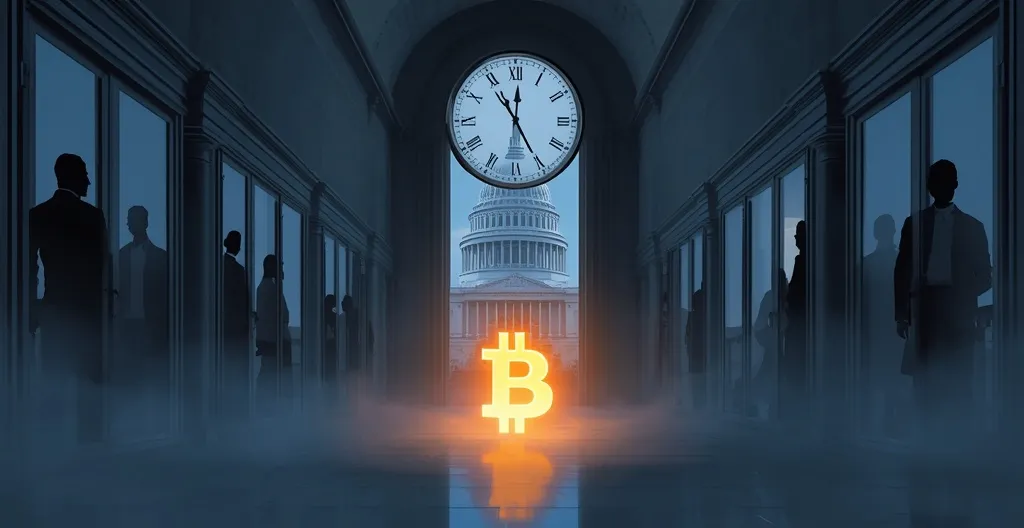
The CLARITY Act is running out of time in the Senate, and Jefferies says the odds of getting it across the finish line before the August recess are slipping. That is bad news for anyone hoping for durable U.S. crypto rules instead of the usual fog, turf wars, and procedural gamesmanship.
- Polymarket odds for passage by end-2026 are down to 48% from 70% in mid-May
- About 20 legislative days remain before the August recess
- Committee approval is not enough; the Senate still needs 60 votes to advance the bill
- Coinbase, Circle, and Bullish are seen as especially exposed to headline-driven swings
- Agency guidance helps, but only a law can provide lasting clarity
Jefferies analysts, led by Andrew Moss, warned Monday that the CLARITY Act Faces Sub-50% Odds as Senate Clock Ticks Toward the finish line is getting tighter as the Senate clock ticks down. The bill is supposed to give the crypto sector a real market structure framework. Plain English version: a law that says which regulator oversees which parts of crypto trading, custody, and digital asset activity.
That sounds basic. In Washington, basic is often where things go to die.
The CLARITY Act cleared the Senate Banking Committee on May 14 in a 15-9 bipartisan vote, with support from all Republican members and two Democrats. But that is only the first checkpoint. Before any full Senate vote, lawmakers have to reconcile the Banking Committee bill with the Senate Agriculture Committee’s Digital Commodity Intermediaries Act, line it up with the House-passed H.R. 3633, and then survive the Senate’s 60-vote cloture hurdle, the threshold needed to end debate and move forward.
That last step is the real choke point. A bill can look alive in committee and still get trapped by Senate procedure, where a minority can slow everything to a crawl. In other words: the legislative equivalent of getting stuck in traffic behind a guy merging at 12 mph.
Jefferies said roughly 20 legislative days remain before the August recess. That means 20 days when the Senate is actually in session, not 20 calendar days of leisurely optimism. As of late June, no merged text had been published, which matters because every unresolved difference makes the eventual compromise harder to land.
The sticking points are familiar and ugly. Jefferies pointed to ethics provisions added during committee markup, illicit finance language, and objections from law enforcement to specific DeFi exemption wording. Those are the kinds of issues that can blow up a crypto bill even when the broad political goal sounds popular.
DeFi stands for decentralized finance, meaning financial activity that runs on blockchains through smart contracts rather than through traditional intermediaries. The appeal is obvious: fewer gatekeepers, more open access, and less dependence on legacy finance. The risk is just as obvious. If exemptions are written too loosely, criminals and grifters will happily treat “decentralized” as a get-out-of-jail-free card.
Jefferies warned that failure to pass the bill before the August recess could push it into next year, or even later if Democrats flip the Senate in November. That is a political scenario, not a certainty, but it is not hard to see why the market is nervous. Crypto legislation has a habit of getting chewed up by election timing, committee turf wars, and the kind of process drag that makes paint drying look efficient.
The odds are already moving. Polymarket now shows a 48% chance of passage by the end of 2026, down from 70% in mid-May. Galaxy Digital’s Alex Thorn also trimmed his estimate on June 26, cutting his probability from 60% to 50%. JPMorgan made a similar call earlier in June, saying the bill may only have a limited window this year.
Prediction markets are not prophecy. They are a crowd-sourced temperature check on what participants think is likely. But when multiple desks and market watchers start leaning the same way, it usually means the easy optimism is gone.
That matters for crypto-linked equities, too. Jefferies flagged Coinbase, Circle, and Bullish as especially exposed to legislative headlines. The logic is straightforward.
Coinbase sits right in the middle of the U.S. crypto market structure fight. If Washington gives exchanges clearer rules, that is generally a win for a public company trying to operate inside the system rather than around it. A recent Coinbase Backed Clarity Act Advances: Tim Scott Eyeing update underscored how closely the exchange is tied to the bill’s momentum.
Circle, meanwhile, is tied directly to stablecoin policy and the economics around USDC. If lawmakers clarify how payment stablecoins can be issued, used, and rewarded, that could shape how much room Circle has to grow, and how much of that growth can be monetized without regulators getting itchy.
Bullish is more of a sentiment trade, but it still lives and dies on the sector’s regulatory mood. When the market thinks Washington might finally stop treating every digital asset like a radioactive object, crypto-linked stocks can catch a bid. When that hope fades, they can get thumped just as fast.
Stablecoins are another pressure point. The notes cite Standard Chartered as estimating that permissive stablecoin-yield rules could redirect up to $500 billion in deposits. That figure should be treated as a projection, not a settled fact, but the larger issue is real: if stablecoin products start behaving like savings accounts, banks will scream about deposit flight and regulators will worry about a shadow-banking workaround wearing a crypto costume.
The SEC has helped soften the near-term environment, but only a little. Jefferies said guidance from the SEC, CFTC, and OCC has improved conditions for the market, yet that guidance is reversible. That is the key weakness. A staff bulletin or no-action letter can be helpful today and meaningless tomorrow if a new administration changes course.
The SEC’s April 4, 2025 statement on Division's View on Covered Stablecoins and Securities is a good example. The agency said that, in the described structure, those stablecoins are not securities and that minting and redemption transactions do not require Securities Act registration. That is useful, but it is not a blanket blessing for every stablecoin wrapper, reward program, or yield-linked arrangement layered on top of them.
And that is where the real fight starts. A payment stablecoin backed one-for-one by reserves is one thing. A product that offers rewards or looks economically like a deposit is something else entirely. Once stablecoin yields enter the chat, the clean lines disappear and everyone starts arguing over whether the thing is a payment tool, a bank substitute, or just a regulatory loophole with good branding.
This is why legislation matters more than agency mood music. Future administrations can reverse guidance, reinterpret enforcement positions, or quietly withdraw staff statements. A statute is harder to unwind and gives the market a sturdier base to build on, even if the law still leaves plenty of room for future rulemaking and legal fights.
The broader debate is really about jurisdiction. The CLARITY Act Sparks Senate Showdown: DeFi and Crypto and the Senate Agriculture Committee’s Digital Commodity Intermediaries Act both touch the same central question: should the SEC or the CFTC oversee digital assets, and under what conditions? Until those lines are drawn with some degree of durability, crypto businesses are left guessing which regulator will show up next.
That uncertainty is exactly why the August recess matters. Once Congress slips past that window, momentum tends to die, lobbyists reset, and the bill risks becoming next year’s talking point instead of this year’s law. The Senate loves a good stall. It treats deadlines like polite suggestions.
There is also the broader market-structure angle, which has become increasingly hard to ignore. The Senate Banking Committee Advances Crypto Market framework is not just some abstract Capitol Hill exercise; it could decide how exchanges, brokers, custodians, and token issuers are treated for years to come.
And while lawmakers continue to posture, some firms are already trying to shape the battlefield. The Coinbase Backs Stablecoin Regulation as Senate CLARITY Act push shows where the industry’s stronger players want the guardrails to land: clear enough to build on, but not so restrictive that U.S. crypto gets kneecapped by regulatory overreach dressed up as consumer protection.
Bitcoin itself is not the main target of this fight, but it is still in the blast radius. A stronger legal framework can help with custody, access, and self-sovereign ownership, while sloppy policy can make legitimate users collateral damage in a bureaucratic tantrum. That is why the Senate Draft CLARITY Act Boosts Bitcoin Self-Custody angle matters: not every win in crypto policy is about pricing or speculation. Some of it is simply about protecting the right to hold your own keys without being treated like a suspect.
For those who track the legislative weeds, the debate is also intersecting with the GENIUS Act, another reminder that stablecoin policy is no longer some side quest. It is a core battlefield in the larger fight over payments, banking, and who gets to control the rails.
There is a good reason this all feels so messy. Crypto doesn’t fit neatly into old categories, and old-guard institutions hate that. The technology is open, borderless, and permissionless by design, which is exactly why bureaucrats keep trying to cram it into categories that were built for fax machines and branch networks. Spoiler: it doesn’t fit.
The broader policy mood has also made it harder to pretend everything is fine. The SEC’s own policy statements, the Senate’s committee jockeying, and the market’s weakening odds all point in the same direction: the easy part is over. Now comes the actual fight over what U.S. crypto regulation will look like when the theater of bipartisan concern gives way to the small print.
This is why legislation matters more than agency mood music. Future administrations can reverse guidance, reinterpret enforcement positions, or quietly withdraw staff statements. A statute is harder to unwind and gives the market a sturdier base to build on, even if the law still leaves plenty of room for future rulemaking and legal fights.
The blunt takeaway is simple: the CLARITY Act is not dead, but it is under real pressure. Senate procedure, unresolved policy disputes, and a brutal calendar are all working against it. Crypto has waited long enough for clear rules. Whether Congress can actually deliver them before the Senate does what it does best, sit on its hands and call it deliberation, is still very much up in the air.
Key questions and takeaways
-
Why does the August recess matter so much?
Because the Senate calendar is tight and unforgiving. If lawmakers do not make real progress before recess, the bill may lose momentum and get pushed into next year. -
Why is the 60-vote threshold such a big deal?
In the Senate, major bills usually need 60 votes to overcome a filibuster. That means committee approval is not enough; supporters still need a broad enough coalition to actually advance the bill. -
What is the CLARITY Act trying to do?
It aims to create a clearer legal framework for crypto market structure, including which regulator oversees which digital assets and intermediaries. That is the core SEC-versus-CFTC jurisdiction fight. -
Why are Coinbase, Circle, and Bullish being watched so closely?
These companies are highly sensitive to U.S. crypto regulation. Clearer rules could support their businesses, while delays or failures can keep volatility high and uncertainty alive. -
What is the stablecoin-yield fight really about?
It is about whether stablecoin-linked rewards or returns start looking like deposit products or investment products. That threatens banks, complicates regulation, and raises questions about consumer protection. -
Is agency guidance enough on its own?
No. Guidance can improve the short-term operating environment, but it can be changed by future regulators. Only legislation gives the market something durable to rely on.
The blunt takeaway is simple: the CLARITY Act is not dead, but it is under real pressure. Senate procedure, unresolved policy disputes, and a brutal calendar are all working against it. Crypto has waited long enough for clear rules. Whether Congress can actually deliver them before the Senate does what it does best, sit on its hands and call it deliberation, is still very much up in the air.