
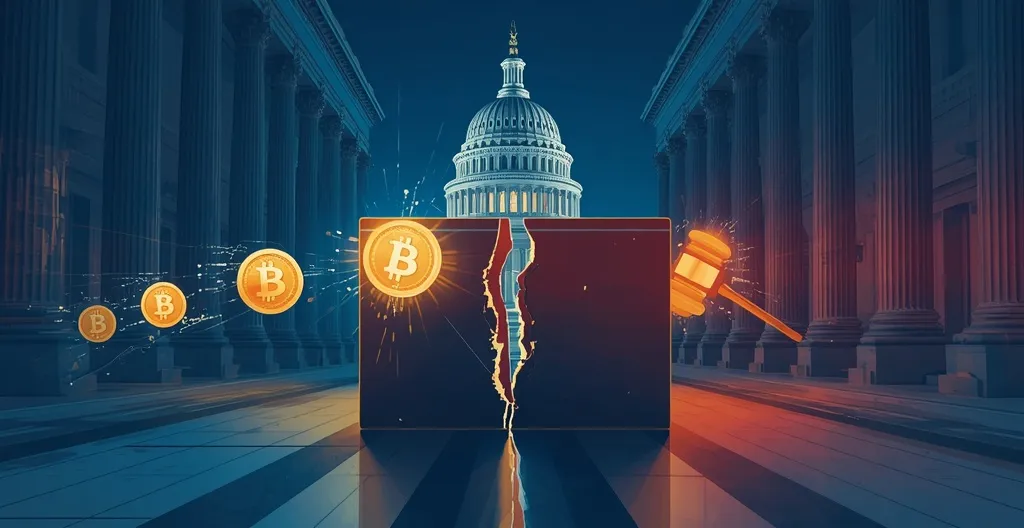
CLARITY punted to September as parties, stakeholders far as the crypto lobby, banks, prosecutors, and Trump all pull in different directions
The Senate’s crypto market structure bill has hit a wall. The reason is simple: too many factions want different outcomes, and none of them are ready to swallow hard.
- Vote delayed: cloture now set for September 15
- Three open fights: ethics, stablecoin rewards, DeFi liability
- Politics everywhere: White House tensions, bank pressure, PAC money, Trump crypto baggage
On Friday, August 7, Senate Majority Leader John Thune said there would be no cloture vote on the CLARITY Act before the Senate’s month-long summer break. He later filed cloture at 4:52 a.m. Saturday, setting up a vote for Tuesday, September 15. CLARITY Act Stalls as Democrats Demand Trump Crypto Ethics
That vote matters because cloture is the Senate’s gatekeeper. It takes 60 votes to move past it, and there are only three sitting weeks left on the calendar before the chamber breaks again ahead of November’s midterm elections. That is not much time to clean up a bill this loaded with landmines.
Thune said Democrats were “insistent” that there be no vote while several key issues remain unresolved. Fair enough. The bill is now carrying three separate fights at once: ethics language tied to Trump’s crypto interests, a stablecoin rewards debate that has banks on edge, and a dispute over how much legal protection DeFi developers should get when criminals abuse open-source software.
The ethics fight is the most politically radioactive. The proposal is meant to curb crypto profiteering by public officials, with Trump as the obvious center of gravity. Ruben Gallego, the Arizona Democrat leading the charge, said the proposal would end Trump’s “crypto grift” and claimed it would have prevented “the $1.4 billion in corrupt earnings” he says Trump has made this term.
That is Gallego’s claim, not a verified ledger entry, but it shows the mood in the room. Trump’s own response was characteristically dismissive. In an interview released on August 7, he said Democrats want him “to be different than everybody else, ” and said he would not mind “putting [his crypto ventures] in a blind trust.”
The current ethics language reportedly leaves charging decisions to the Attorney General. That would be Todd Blanche, who was approved by the Senate last Friday and is also Trump’s former personal attorney. If the arrangement sounds awkward, that’s because it is.
According to Politico, proposed Gallego-Thillis revisions would let state attorneys-general sue the Department of Justice if it fails to act on ethics violations. They would also let state AGs bring charges against digital asset exchanges that list tokens violating the ethics proposal. In plain English: Democrats do not trust DOJ alone to police this, and they want another set of hands on the wheel.
Bloomberg reported that the proposed forced divestment could let Trump defer federal taxes on gains for years, potentially forever. Without that deferral, Bloomberg said he could face an immediate 20% tax on capital gains from his crypto investments. That is the kind of detail that turns a clean-up provision into a tax-law brawl.
Republicans are split too. On August 5, Thom Tillis said negotiators had “people working with the White House right now … they’re going through some of the lines right now.” The next day he walked that back, saying negotiators had not heard anything from the White House about the latest proposal.
That is not exactly the sign of a tight operation. Tillis later said the odds of CLARITY passing “probably drops in half” because the debate was pushed to September. JPMorgan Says CLARITY Act Faces Fading Odds as Senate
Cynthia Lummis, one of the Senate’s loudest crypto defenders, said, “you can imagine how frustrated I am.” She later added that if CLARITY “dies, it’s gonna be because the Democrats killed it.”
That leaves out the GOP’s own internal mess, which is centered on stablecoins.
The GENIUS Act, approved by Congress one year ago, barred stablecoin issuers from offering holders yield or interest. CLARITY would allow non-issuing platforms to offer “rewards” for certain stablecoin-related activities. Banks hear that and see a workaround with lipstick on it.
Jerry Moran of Kansas said he was “unable to support” CLARITY without “a different outcome” on stablecoins. He warned the bill could have “consequences on the people who rely upon banks in small towns across Kansas.” Josh Hawley of Missouri went further, saying he was officially “no” unless the stablecoin text changes. Hawley said farmers and ranchers are “very, very concerned” that deposit flight could “absolutely kill” agriculture loans. White House Crypto Advisor Slams Banks Over Stablecoin
That concern is not coming out of nowhere. The Independent Community Bankers of America circulated polling saying 86% of U.S. small business professionals believe crypto policy should avoid harming bank lending in local communities. It also said small business respondents agreed two-to-one that policymakers should prohibit crypto companies from offering interest-like rewards.
ICBA CEO Rebeca Romero Rainey said, “we are leaving no stone unturned so that lawmakers recognize the danger of deposit flight as [CLARITY] is written.” Brad Bolton, CEO of Community Spirit Bank in Alabama, said “what really shifted the tone was when it wasn’t the big banks telling the story anymore.”
That is the political tell. When local bankers and farm-state senators start talking about deposits, the debate stops sounding like a shiny fintech pitch and starts sounding like a fight over who gets to keep the money in town.
John Kennedy of Louisiana said pressure from banks has “given some people pause.” Lummis, meanwhile, argued CLARITY’s stablecoin language is “actually tougher than current law, not looser.” Bernie Moreno, after being asked about “big kinks left to iron out, ” snapped: “There is absolutely nothing to ‘iron out.’”
Maybe. But the fact that this is still being argued over at all says otherwise.
Lummis and Moreno also signed on as co-sponsors of the Credit Card Competition Act, which would lower credit card swipe fees. The banking sector hates that too and previously wanted the CCCA kept off CLARITY in hopes of securing support for the GENIUS Act. Washington’s favorite sport remains bundling unrelated grievances into one giant mess.
The third major fight is illicit finance, especially the legal exposure of noncustodial DeFi developers. Noncustodial means the developers do not hold user funds. That matters because the question is whether software writers should be treated like financial operators when criminals misuse the code.
On July 28, Politico reported that the National Association of Assistant U.S. Attorneys and the National District Attorneys Association, with help from Sen. Catherine Cortez-Masto, proposed text for CLARITY’s Blockchain Regulatory Certainty Act section. Their version would make clear that DeFi references do not “create, expand, or modify criminal liability under Federal law.” Cortez Masto Statement on CLARITY Act
That proposal would remove a BRCA amendment inserted earlier this year by Lummis and Sen. Chuck Grassley. That amendment requires prosecutors to prove noncustodial developers knowingly facilitated illicit transactions, including money laundering, before charging them.
Patrick Witt, the White House crypto adviser, said the administration had “made our position abundantly clear to Senator Cortez-Mastro for weeks.” Treasury officials were blunter, calling the prosecutors’ proposal “language drafted by Washington lobbyists” and saying it “guts protections for software developers and greenlights new liability when none currently exists.”
The policy question is real. Prosecutors want enough room to go after bad actors. Developers want to avoid becoming the default scapegoat every time criminals use open software they did not control. The line between “code” and “criminal conspiracy” is where this whole thing gets ugly.
CLARITY also includes a promise of $600 million in funding to train police on tracking digital assets. Punchbowl News reported Senate Democrats told police groups that funding might not actually be provided. That would be a bad look for a bill already struggling to project seriousness. The Clarity Act August 10 Final Deadline
Key questions readers keep asking
-
Why was the CLARITY vote delayed?
Because lawmakers do not agree on the bill’s ethics text, stablecoin rewards language, or DeFi liability rules. Thune could not move it cleanly before the Senate’s August break, so the first real hurdle is now a September 15 cloture vote. Senate Delays Clarity Act Vote Amid Crypto Ethics Debate -
What is the biggest roadblock?
The ethics fight around Trump’s crypto interests is one of the biggest obstacles, but it is not the only one. Stablecoin rewards and DeFi liability could each derail support on their own. -
Why are banks so angry about stablecoin rewards?
Banks worry “rewards” are just yield with better branding. Their fear is deposit flight, meaning money could leave local banks and hurt lending in small towns and farm country. -
What is the DeFi fight really about?
It is about whether software developers should face criminal exposure when criminals use decentralized tools they do not custody or control. Prosecutors want more flexibility; developers want a hard line protecting software from being treated like a crime scene. -
Does crypto money still swing elections?
It still matters, but it is not magic. Crypto PACs can boost allies, but recent primaries show spending does not guarantee victory if the candidate is weak or the backlash is strong.
That last point is getting harder for the industry to ignore. Crypto-focused PACs reportedly have over $130 million on hand, but the results have been uneven. In Michigan’s 13th District, Fairshake’s offshoot Protect Progress spent $2 million backing Rep. Shri Thanedar, and he still lost his primary to state Rep. Donavan McKinney.
McKinney attacked Thanedar for crypto industry support, saying the industry wanted to “pay Shri back for the votes he took allowing Trump to make over $1 billion off crypto.” That $2 million miss is smaller than the $10 million Fairshake and affiliates spent in a losing Illinois Senate primary in March, which is a reminder that money can buy noise, not necessarily loyalty.
Mark Hays of Americans for Financial Reform put it bluntly: “the tides have shifted.”
Still, the PACs are not toothless. Fairshake’s Republican arm, Defend American Jobs, spent $512, 000 supporting Rep. Bill Huizenga in Michigan, helping him win his GOP primary. It also spent $510, 000 supporting Amanda McKinney in Washington’s 4th District, helping her win there too.
Protect Progress spent more than $100, 000 each on Suzan Delbene, Kim Schrier, and Marilyn Strickland, all of whom won their Democratic primaries. So yes, the money still moves. It just no longer looks invincible.
In Minnesota, Democrats hold a primary on Tuesday for an open Senate seat, where Lt. Gov. Peggy Flanagan criticized rival Rep. Angie Craig for voting “to let Trump make billions selling crypto coins.” Craig has not yet received crypto PAC cash, though Coinbase executives gave $63, 000 and other crypto firms added more than $40, 000. 119th Congress (2025-2026): Digital
Defend American Jobs is also spending heavily ahead of August 18 primaries, including over $500, 000 to boost Nicholas Begich in Alaska’s 1st District. It backed Sydney Gruters in Florida’s 16th District and Harriet Hageman in Wyoming’s Senate race as well.
All of that is happening while Trump-linked crypto ventures are under real financial pressure.
The New York Times recently published a report on Trump’s World Liberty Financial project, and blockchain sleuths thought they detected another major token sale by Trump Media & Technology Group. TMTG said the transfer of $165 million worth of BTC to Crypto.com was not a sale, just a transfer. Either way, the company is spending a lot of time explaining crypto movements that look less than comforting from the outside. CLARITY Act Stalls as Democrats Demand Trump Crypto Ethics
TMTG has also scrapped its digital asset treasury strategy based on Cronos and its native CRO token. It and Crypto.com agreed to “mutually terminate” the plan, citing “prevailing market conditions, and shifting business and stakeholder priorities.” Eric Trump said many DATs “are just kind of dead in the water … the cost of being public is eating them alive.”
The company’s direct servicing partnership tied to Yorkville America’s anticipated ETF offerings was also dropped, and its Truth Predict prediction-market plan with Crypto.com was turned into a marketing agreement. That is not exactly the behavior of a company charging into the future. It looks more like a series of escape hatches being installed in real time.
TMTG shares fell 8% on Monday. They are down nearly one-third since the year began and nearly 45% below where they traded 12 months ago.
The company spent nearly $1.4 billion to acquire 11, 542 BTC last year at an average price of $118, 522. In its Q2 report, it said it held 9, 477 BTC worth $557 million, with more than $1 billion said to be the cost of those coins. Of that stack, 4, 261 BTC are pledged as collateral for debt notes due in May 2028, and another 2, 077 BTC are tied to its options strategy.
TMTG’s stack of more than 756 million CRO tokens is unchanged, but the value of those tokens has fallen 40% since New Year’s Eve to $40.6 million. The original cost of the CRO was about $114 million.
The company reported revenue of $1.7 million for the three months ending June 30, while issuing nearly five times that amount in stock-based compensation. It booked a net loss of more than $238 million, bringing first-half losses to $644 million.
TMTG also said its Truth API subscription service, which charges between $60, 000 and $100, 000 per month, has signed “more than 10 customer agreements to date.” That is a real product. It is also a tiny island in a very large red sea of losses.
The bigger picture is pretty clear. Crypto still has money, influence, and some genuinely serious policy arguments. It also has weak spots, ugly conflicts, and a habit of turning every legislative debate into a loyalty test.
CLARITY is headed into September with too many loose ends and too many people trying to use it as a vehicle for something else. That is not an accident. It is what happens when market structure, open-source software, bank lobbying, and a former president’s crypto dealings all get stuffed into the same bill and left to bake under Senate lights.