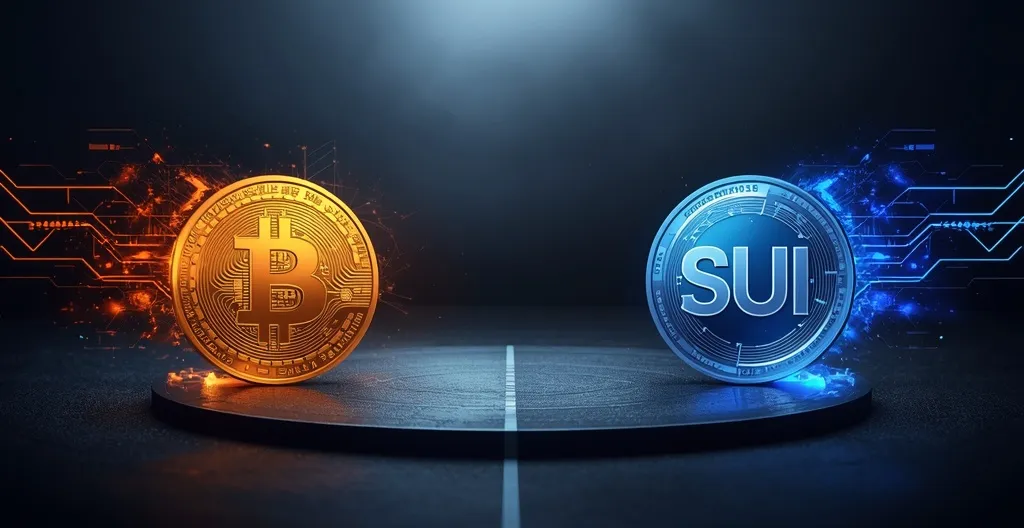
BNB and SUI are not competing on the same terms. BNB is the older, more established asset with real utility, recurring burn mechanics, and a close tie to Binance and the broader BNB Chain ecosystem. SUI is the younger challenger, faster, more experimental, and built for bigger upside if the market decides to reward growth again.
- BNB: mature, revenue-linked, supply-reducing
- SUI: newer, faster, higher-beta, still proving itself
- Market backdrop: Bitcoin dominance remains high, so altcoins are not getting an easy ride
- Reality check: burns help scarcity, but they do not magically create demand
That is the whole fight in one sentence: BNB offers stability and cash-flow-like utility for a crypto asset, while SUI offers more torque if altcoins finally catch a bid. One is the safer workhorse. The other is the sharp knife.
Analyst Dami Defi put the comparison bluntly on X: “Two smart contract ecosystems. One dominates through scale. The other is chasing explosive growth. Which deserves your capital today?” Fair question. The answer depends on whether you want something proven or something with more room to surprise.
BNB: the large-cap with a real supply story
BNB is the native token of the BNB Chain ecosystem, and it still does actual work. It is used for network fees, decentralized applications, and trading fee discounts on Binance. That gives it two demand drivers, on-chain utility and exchange-linked utility.
That distinction matters. BNB is not just a token with a famous logo. It is the lubricant for a sprawling ecosystem, but it also benefits from Binance’s distribution power. The same relationship that gives BNB reach also creates concentration risk. Crypto rarely hands out free lunches.
One of BNB’s strongest features is its burn program. BNB has an ongoing Auto Burn mechanism that permanently removes tokens from circulation, and the target supply remains 100 million tokens. According to the material cited by Dami Defi, more than $1 billion worth of BNB was permanently burned in Q1 2026.
That is the kind of supply discipline investors like to see. But let’s not oversell it. A burn reduces supply; it does not guarantee price appreciation. If demand is weak, a shrinking float just means holders can watch their token become scarcer while the chart still behaves like a broken shopping cart.
Dami Defi called BNB “the blue-chip exchange ecosystem with unmatched profitability.” That is a loaded phrase, but the basic point is reasonable. BNB has scale, usage, and a mature ecosystem behind it. According to the comparison, BNB Chain holds about $6.8 billion in DeFi total value locked, stablecoins worth roughly $13.3 billion operate on the network, and the ecosystem hosts nearly 69, 000 AI agents. The Real World Asset ecosystem has also expanded to roughly $3.8 billion.
Those figures are directional evidence that BNB Chain is not dead money. They show a network with breadth, active users, and multiple narratives layered on top of each other: DeFi, stablecoins, AI, and tokenized assets. That is real ecosystem density, not just a whitepaper with a fancy font.
Still, BNB’s biggest weakness is obvious. It is tightly linked to Binance, and Binance is not some sleepy neutral protocol. It is a giant, corporate-adjacent market force with regulatory baggage, legal history, and a centralization profile that makes purists wince. The chain can be useful and profitable without being a decentralization shrine.
There is also a downside to maturity that crypto traders hate hearing. Big, established assets often have a harder time expanding multiples. A mature ecosystem can mean steadier fundamentals, but it can also mean slower upside. BNB may be more defensible, but it may not be the fastest horse if the market enters pure speculation mode.
SUI: faster architecture, more growth optionality
SUI is the native token of the Sui Network, a Layer 1 blockchain built around parallel transaction processing. In plain English, that means it can process multiple transactions at the same time rather than lining everything up in one long queue. The goal is speed, lower costs, and better throughput.
Sui uses the Move programming language and is aimed at decentralized applications, gaming, and digital commerce. It also leans hard into user experience, including zkLogin, which lets users sign in with familiar web credentials while reducing the Web3 headache. Translation: less wallet fumbling, fewer onboarding faceplants.
The strongest case for SUI is not that it is perfect. It is that it has a credible technology stack and room to grow. According to the material tied to Dami Defi, Sui’s DeFi total value locked grew from roughly $250 million to about $2.6 billion, cumulative stablecoin transfers have exceeded $1 trillion, and more than 228 million cumulative active addresses have interacted with the network. Those are the kinds of numbers that make a newer chain look less like a science project and more like a live network.
There is also an institutional narrative forming around it. The supplied notes say CME futures are now available for SUI and that three U.S. staking ETFs have launched through Grayscale, Canary Capital, and 21Shares. The more firmly supported part here is that Sui has attracted institutional product activity, including Canary Capital’s SUIS spot ETF on Nasdaq, which the Sui blog says is designed to track SUI and capture staking rewards. Grayscale and 21Shares are also mentioned in connection with Sui-linked products or strategic initiatives.
That does not make SUI a guaranteed winner. It does mean the network is getting more than hobbyist attention. Institutional rails matter because they can widen access, improve credibility, and pull in capital that would otherwise sit on the sidelines. They are not magic, but they are not meaningless either.
SUI’s other big selling point is its room to run. According to the notes, only about 40% of the total supply currently circulates, and unlocks continue through 2030. That exact supply profile was not independently verified in the material provided, so the safer takeaway is simple: SUI still faces meaningful unlock pressure over the coming years. That matters. A token with future emissions has to work harder to justify itself.
And that is the catch. SUI’s upside case depends more heavily on adoption. If the ecosystem keeps growing and the market enters a real altcoin rotation, SUI can run hard. If not, it can sit there being technically impressive while the price does absolutely nothing useful for holders.
The market backdrop is still favoring Bitcoin
This comparison sits inside a market that is still not giving altcoins an easy win. The provided market snapshot puts total crypto market capitalization near $2.16 trillion, with the market down roughly 3.33% over the past month. Bitcoin dominance remains near 57.82%, and the Altcoin Season Index sits around 48. Fear is still the dominant mood.
That matters because when Bitcoin dominates, smaller tokens usually struggle to sustain momentum. Capital flows into BTC first. Only later, if confidence improves, do traders start reaching for higher-beta altcoins. Right now, that rotation is not exactly ripping faces off.
In that kind of environment, BNB tends to look steadier. It is larger, more liquid, and backed by an ecosystem that already produces real usage. SUI may have more upside if the market broadens out, but it also has more fragility. That is the price of being earlier in the game.
What the numbers actually say
BNB’s case rests on a fairly simple idea: utility plus scarcity plus scale. It is used across the BNB ecosystem, it benefits from Binance-linked demand, and its supply keeps shrinking through burns. According to the cited material, BNB has a market capitalization of $77.5 billion, and its circulating supply is already substantial, which means future upside has to come from demand growth more than from supply shock fantasies.
SUI’s case is more speculative but potentially more explosive. The network is younger, its ecosystem is still expanding, and it has more room for the market to reprice expectations. But that same setup comes with dilution risk and a higher dependence on sustained adoption. If growth slows, the market will not hand out participation trophies.
That also means network quality and token performance are not the same thing. A chain can be technically solid and still underperform. A token can have decent tokenomics and still go nowhere. Crypto has a long and embarrassing history of making competent people look foolish while garbage narratives get bid to the moon for reasons nobody can fully explain.
Price levels traders are watching
The supplied technical snapshot has BNB trading near $571.92. It is slightly above its recent 7-day average, but below its 30-day and 200-day averages. Short-term RSI is close to neutral, and MACD has started improving, though no strong bullish reversal is confirmed.
The scenario levels listed for BNB are:
- Bullish: $630 to $650
- Base: $540 and $620
- Bearish: $500 to $520
- Deeper weakness: around $486
SUI is shown around $0.75, almost 86% below its previous all-time high. It is slightly above its short-term average and close to its 30-day average. Recent RSI readings have moved into stronger territory, while medium-term readings remain near neutral.
The scenario levels listed for SUI are:
- Bullish: $0.90
- Base: $0.68 and $0.82
- Bearish: $0.60
Those levels are reference points, not prophecy. Crypto loves to turn tidy charts into shredded paper the moment liquidity changes its mind.
Which token looks better this cycle?
If the question is which one looks stronger on fundamentals, BNB gets the edge. It has broader utility, a more mature ecosystem, a clearer supply-reduction model, and a track record that SUI cannot yet match. It is the more defensible hold if you want something established.
If the question is which one has more upside if altcoins catch fire, SUI is the more aggressive bet. It has newer technology, more growth optionality, and more room for the market to get excited about its trajectory. But that upside comes with unlock risk, higher volatility, and the usual possibility that the market decides to rotate into something else tomorrow.
That is the honest read: BNB is the steadier large-cap alt with real utility and a shrinking supply base. SUI is the higher-beta challenger that needs adoption, not just applause. In a BTC-dominant market, BNB is the more defensible choice. In a strong altseason, SUI has the sharper torque.
For traders trying to position around broader market rotation, the bigger framework still matters. A lot of capital is waiting on a clean shift from Bitcoin into larger altcoins before the smaller names get their moment, which is why resources like Crypto ETF Trading Strategies for 2026 and Altcoin Season 2025: Top 5 Altcoins to Watch as Bitcoin keep showing up in portfolio chatter. ETFs may broaden access, but they do not suspend gravity or cure bad tokenomics.
Key questions and quick answers
-
Is BNB the safer hold?
Generally, yes. It has more maturity, stronger utility, and a deflationary supply model, but it also carries Binance-related regulatory and concentration risk. -
Does SUI have more upside?
Potentially. SUI is the higher-risk, higher-reward bet, and it could outperform hard if the market rotates into altcoins and adoption keeps growing. -
Which token has the better supply story?
BNB. Its burn program steadily reduces supply. SUI appears to face more future unlock pressure, which can weigh on price if demand does not keep up. -
Do burns guarantee price gains?
No. Burns help scarcity, but price still depends on demand, liquidity, and market sentiment. Tokenomics are not a cheat code. -
What matters most right now?
The market regime. With Bitcoin dominance still high and fear still hanging around, altcoins need a friendlier environment before they can really stretch.
For readers who want a more side-by-side framing, there are also ongoing market debates around BNB vs SUI: Which Token Is Better to Hold This Crypto and deeper token-specific breakdowns like What BNB Actually Does (and Why It Matters for Price). Both sides have a case. The trick is not mistaking enthusiasm for due diligence.
Institutional access is also part of the backdrop now, whether people like it or not. Products such as the Launch of SUIS ETF Expands Institutional Access to Sui show how quickly tradfi wrappers can change a token’s audience, while broader coverage around Binance Dominates with $7 Trillion Spot Volume in 2025, But keeps the centralization debate alive where it belongs.
Bottom line: BNB is the stronger established asset, SUI is the more speculative growth bet, and the market still has to decide whether it wants safety, speed, or just more Bitcoin. For now, BTC remains the adult in the room, and the alts are still fighting for the snacks.