
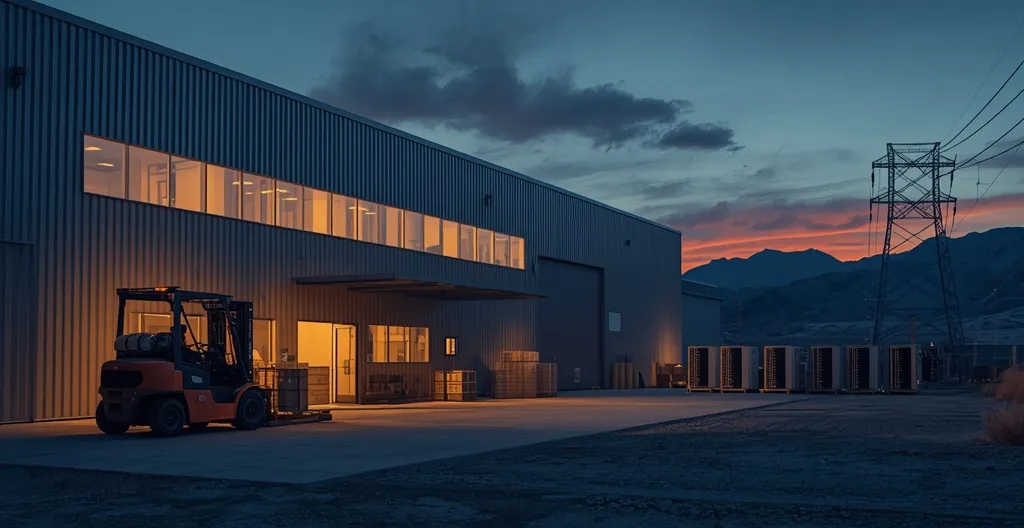
Bitdeer is putting a real factory behind its Bitcoin hardware push, with a $36 million manufacturing site in Sparks, Nevada aimed at strengthening its control over the SEALMINER supply chain.
- $36 million facility in Sparks, Nevada
- Set to support SEALMINER Bitcoin mining equipment
- Bitdeer shares rose 14.1% to $14.33
- Company reported a strong May with 921 BTC mined, up 370% year over year
For a sector crowded with slide decks, vague “strategic pivots, ” and too many executives trying to dress up debt with the word AI, an actual factory is a different beast. It shows Bitdeer is not just chasing hash rate, it wants more control over the machinery that creates it.
The Sparks site is designed to make SEALMINER Bitcoin mining machines in the United States. That should give Bitdeer more control over production, timing, and supply. In mining, that matters. Waiting on outside suppliers can mean delays, higher costs, and less flexibility when the market turns nasty, which it often does.
That said, “more control” is the right phrase here. The available details do not make it sound like Bitdeer is magically eliminating its dependency on third-party suppliers altogether. This looks more like a step toward tightening the chain than a total onshoring of every moving part. Still, in Bitcoin mining, even partial control over hardware is a meaningful edge.
Bitdeer said it worked with Nevada Governor Joe Lombardo’s administration and local officials on the project, and the state approved tax incentives, including reduced qualifying sales taxes. That is the usual U.S. industrial bargain. Companies want friendly tax treatment and predictable support, while states want jobs, investment, and a ribbon-cutting photo op that looks good on a campaign flyer.
The market liked the news. Bitdeer shares rose 14.1% on Thursday to $14.33. The stock was still about 27% below its June peak, but it was also up roughly 26% since the beginning of the year. So yes, investors are interested, just not drunk on the story.
The factory push landed alongside a solid operating update. Bitdeer said it mined 921 Bitcoin in May, a 370% increase from the same month a year earlier. That kind of growth is not normal in a business that gets squeezed by rising network difficulty, energy costs, and the relentless math of the Bitcoin halving.
Bitcoin halving is the event that cuts the block reward miners receive for securing the network. Fewer coins per block means thinner margins, especially for less efficient operators. The result is predictable. Miners hunt for better hardware, cheaper power, and new revenue streams before the economics chew them up.
That pressure explains why so many miners are now talking about AI cloud computing and high-performance computing, or HPC. Bitdeer is doing that too, but it has not abandoned its core business. The company is still pushing mining while also building adjacent compute businesses.
AI cloud computing means renting out computing resources for artificial intelligence workloads. HPC refers to high-performance computing, the kind of power-hungry infrastructure used for demanding tasks such as advanced simulations or large-scale model training. In simple terms, if a site has the right power and cooling setup, it may earn money from more than one type of workload, though that is easier said than done.
That distinction matters. A mining facility is not automatically ready to host AI servers just because it has a lot of electricity. The hardware stack is different, the networking requirements are different, and the commercial contracts are different. Power alone is not a business model. Too many companies act as if it is.
Bitdeer’s broader strategy shows why the factory announcement matters beyond one plant in Nevada. The company reported total global electrical capacity of 3, 003.5 MW, with 1, 797 MW online and 1, 206.5 MW in the pipeline. For readers new to the jargon, MW means megawatts, a measure of power capacity. Online capacity is already operating, while pipeline capacity is planned but not yet producing cash.
The company also said its total hash rate under management reached 83.1 EH/s in May, up from 27.4 EH/s a year earlier. EH/s stands for exahashes per second, a measure of mining scale and speed. Bitdeer’s self-mining hash rate rose to 70.2 EH/s from 13.6 EH/s over the same period. Those are not boutique numbers. They point to a company operating on serious industrial scale.
Bitdeer’s AI cloud business is no sideshow either. The company said it has 4, 248 GPUs deployed, a utilization rate of 89%, and annual recurring revenue of about $69 million. It also said 3, 305 GPUs were under external subscription. That is real deployed infrastructure with customers attached, not just a buzzword stapled to a data center.
Still, scale and profitability are not the same thing. Mining companies have a long habit of celebrating capacity before it turns into durable earnings. Pipeline megawatts, negotiations, and future energization dates are not the same as operating revenue. Crypto investors have been burned enough times by “we’re planning to build” stories to know the difference.
Bitdeer’s footprint is wide enough to show ambition and complicated enough to keep execution risk front and center. The company has active sites or projects in the United States, Norway, Bhutan, Ethiopia, Malaysia, and Canada, with some locations still in planning, evaluation, or negotiation. That flexibility can be valuable. It can also become a management headache with enough moving parts to make any operator sweat through their shirt.
The broader mining industry is clearly moving in the same direction. MARA Holdings is planning to acquire a Texas site that could support up to 2 gigawatts of capacity for AI and digital infrastructure projects, while TeraWulf said it signed a 20-year data center lease with Anthropic that it says could generate about $19 billion in revenue over its lifetime. The message is blunt. Many miners are trying to become infrastructure companies before mining economics squeeze them into the dirt.
There is a real difference between a legitimate diversification strategy and a desperate rebrand. Some firms are building durable businesses with actual customers, deployed hardware, and long-term contracts. Others are slapping “AI” on a power-hungry data center and hoping the market does not ask uncomfortable questions. Investors should ask those questions anyway.
Bitdeer’s Nevada move suggests it wants more than a headline. It wants manufacturing control, greater operational resilience, and a stronger position in a business where access to hardware can matter as much as access to electricity. If the factory reaches commercial production by the end of 2026, that could help the company reduce bottlenecks and tighten margins. If it slips, the market will treat the delay like it treats most mining promises: with a raised eyebrow and a cold stare.
Bitcoin mining is still a harsh game. The companies that survive are usually the ones that control more of the stack, hardware, power, infrastructure, and, increasingly, adjacent compute revenue. Bitdeer is betting that making more of its own gear in the U.S. is better than renting the future from someone else.
That is a sensible bet. It is also a hard one. Manufacturing is capital-intensive, margins can get ugly fast, and operating industrial infrastructure is where the fantasy ends and the spreadsheets start fighting back. But if Bitcoin mining is going to keep maturing, this is the kind of boring, practical, built-with-steel move that actually matters.
Bitdeer unveils $36M Nevada factory to shake up Bitcoin
Bitdeer opens $36M Nevada factory to produce 10
Bitdeer Acquires $21M Site in Canada for 99MW Bitcoin
Bitdeer Dumps 2, 000+ BTC: Mining Crisis or Strategic Pivot
Bitdeer Sells All Bitcoin Holdings: Strategic Pivot or
Key takeaways
-
Why does the Nevada factory matter?
It gives Bitdeer more control over production for its SEALMINER hardware and could reduce supply-chain friction. In mining, that kind of control can be a real competitive advantage. -
Is Bitdeer abandoning Bitcoin mining for AI?
No. The company is still expanding mining while also growing AI cloud and HPC operations. That is diversification, not a full retreat from Bitcoin. -
What does the stock move show?
Investors liked the manufacturing announcement and the production update. The move was positive, but the stock still sat below its June peak, so the market is interested rather than euphoric. -
How strong was May production?
Bitdeer said it mined 921 BTC in May, which it described as a 370% increase year over year. That points to rapid expansion, though production still has to be judged against costs, difficulty, and future efficiency. -
Is AI a silver bullet for miners?
No. AI and HPC can diversify revenue, but they also require capital, contracts, customers, and the right infrastructure. They help, but they do not erase the pressure on mining margins.