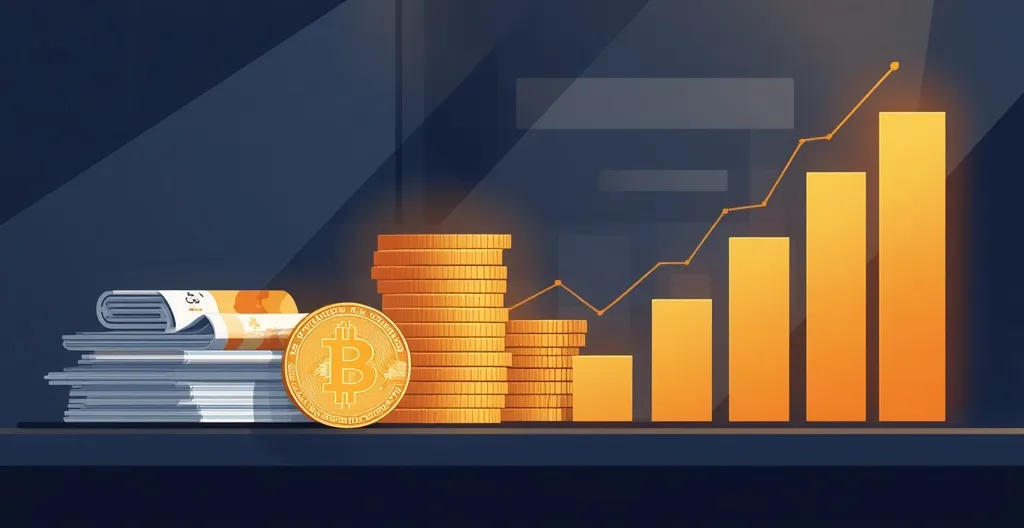

American Bitcoin says its Bitcoin reserve has climbed above 8, 000 BTC, even as the stock behind it needed a 1-for-15 reverse split to stay on Nasdaq’s good side. That is the whole tension in one shot: more Bitcoin on the balance sheet, but still enough market pressure to make the share count look like it went through a shredder.
- Bitcoin reserve tops 8, 000 BTC
- 1-for-15 reverse split to support Nasdaq compliance
- Q1 loss hit by Bitcoin’s price drop and non-cash charges
- Accumulation is being helped by mining, purchases, and dilution
American Bitcoin Corp. said on July 6 that its Bitcoin reserve has grown more than threefold since its Nasdaq debut, and that its satoshis-per-share metric has risen nearly threefold as well. The company’s own post on X framed that as proof the reserve-building strategy is working.
BitcoinTreasuries data placed American Bitcoin at 8, 000 BTC, which at recent prices works out to roughly $512 million. That puts the company in the upper tier of public Bitcoin holders, at least among U.S.-listed names. The number matters because it shows the company is not just talking a big orange game; it is actually stacking coins.
But there is no way to separate that bullish headline from the uglier market reality. ABTC stock has been under pressure, which is why American Bitcoin completed a 1-for-15 reverse stock split. The split became effective at 5:00 p.m. on July 2, and split-adjusted Class A shares began trading on Nasdaq under the ABTC ticker from July 6.
A reverse split is exactly what it sounds like: fewer shares, higher price per share, same underlying ownership value. It does not create new value. It is a cosmetic fix with a compliance purpose, designed here to help satisfy Nasdaq’s minimum bid price requirement. In plain English, the exchange wants your stock above a certain price, and if it keeps trading like pocket lint, a reverse split is the corporate equivalent of combing your hair before a meeting.
American Bitcoin said the split would reduce its issued shares from about 1.09 billion to roughly 73 million. That makes the cap table cleaner and the chart less embarrassing, but it does not answer the harder question: does the business deserve a premium, or just a grudging nod?
For now, the answer is somewhere in the middle.
The company reported an $81.8 million net loss in the first quarter of 2026. That loss included a $117.2 million non-cash charge tied to Bitcoin’s 22% decline during the quarter. A non-cash charge is an accounting hit, not an immediate cash outflow, but it still hurts because public markets read earnings statements with all the warmth of a tax auditor.
There is a key distinction here. American Bitcoin said the underlying mining business was profitable, but the company as a whole still posted a net loss because Bitcoin’s price moved against it. That is standard miner pain: revenue swings with BTC, while expenses, capex, and accounting rules keep marching along like they missed the memo.
The company’s operating numbers were not fake, either. It mined 817 BTC in the quarter and lowered its cost per Bitcoin to $36, 200, down 23% from $46, 900 in the fourth quarter of 2025. It also bought 803 BTC during the quarter, bringing holdings to 7, 021 BTC as of March 31.
That part is important because it shows how American Bitcoin is building its reserve. The company is not just passively holding what it mines. It is self-mining, buying coins, and calling the whole thing a strategic Bitcoin reserve. That makes it a hybrid: part miner, part balance-sheet Bitcoin vehicle, part public-market stress test.
CEO Mike Ho said the company did not sell a single coin, which is exactly the kind of discipline a Bitcoin treasury strategy is supposed to have.
“The underlying business was profitable and we did not sell a single coin, ”
That conviction is nice. The funding structure is the less glamorous part.
American Bitcoin’s reserve growth was supported not only by mining and purchases, but also by equity issuance. According to the company’s Annual Meeting Proxy Statement and Voting Instructions summarized by Bitcoin Foundation, it issued about 84 million Class A shares for roughly $111 million in gross proceeds during Q1, with cumulative ATM proceeds reaching about $351.5 million. An ATM, or at-the-market offering, lets a company sell shares gradually into the market to raise cash. It also dilutes existing holders. There is no free lunch, only a slightly better-funded one.
That is the trade-off investors need to stare at without blinking. The company can stack more Bitcoin, but if a meaningful chunk of that stack comes from issuing new shares, shareholders are effectively helping pay for the accumulation through dilution. That may be acceptable if BTC per share keeps rising fast enough. If not, the magic trick turns into a slow leak.
American Bitcoin was launched in March 2025 by Hut 8 and Eric Trump, with Donald Trump Jr. also backing the company. Hut 8 said the goal was to build a large pure-play Bitcoin miner while developing a strategic Bitcoin reserve. In other words: stay focused on Bitcoin instead of wandering off into shiny side quests.
That focus also separates American Bitcoin from miners that pivot toward AI data centers when Bitcoin economics get ugly. This company is still presenting itself as a Bitcoin-centric play built on self-mining and treasury accumulation. That is cleaner branding. It is also a more direct bet on BTC staying strong enough to support both the reserve and the stock.
And that is where the market keeps its guard up.
Public Bitcoin treasury companies often trade like leveraged versions of BTC, but they do not behave like spot Bitcoin. They carry corporate overhead, mining risk, dilution risk, and the usual public-company nonsense that comes with life on Nasdaq. A rising reserve can help the story. It does not automatically rescue the equity.
The reverse split may improve the stock’s optics. The reserve growth may improve the Bitcoin thesis. Neither one erases the fact that public-market investors still want proof the model can create value without chewing through shareholders to do it.
For American Bitcoin, that is the real test now: can it keep growing its BTC reserve, keep mining efficiently, and avoid turning equity dilution into a permanent part of the business model?
Bitcoin accumulation is the easy headline. Making it accretive without a lot of smoke and mirrors is the part that separates conviction from gimmick.
Key questions and takeaways
-
Why does 8, 000 BTC matter?
It puts American Bitcoin among the larger public Bitcoin holders in the U.S. That gives the company more weight as a treasury play, even if the stock still has something to prove. -
What did the reverse split actually do?
It reduced the share count and raised the per-share price to help with Nasdaq’s minimum bid price rule. It changes the optics, not the underlying value. -
Why did the company still report a loss?
Bitcoin fell 22% in Q1 2026, which triggered a $117.2 million non-cash charge on its holdings. The mining business could still be profitable while the company’s reported net income stays negative. -
Was the reserve growth only from mining?
No. American Bitcoin mined 817 BTC and bought 803 BTC in the quarter, but it also raised cash through an ATM equity program. That means dilution helped fund some of the accumulation. -
Is ABTC the same as owning Bitcoin?
No. ABTC is a public company with mining exposure, treasury exposure, and all the baggage that comes with equity markets. Owning the stock is a very different animal from holding spot BTC.
Further reading
A few useful side notes on reverse splits, treasury-heavy Bitcoin plays, and the policy backdrop around public BTC balance sheets:
- Nasdaq and NYSE rules on reverse stock splits
- Reverse stock split explained
- Hut 8-backed American Bitcoin plans to slash its share count
- American Bitcoin posts $3.5M Q3 profit amid Trump ties and volatility
- U.S. crypto policy advances as Bitcoin reserve and Clarity Act momentum builds
- Brian Armstrong says the U.S. could hold over $1 trillion in Bitcoin reserves