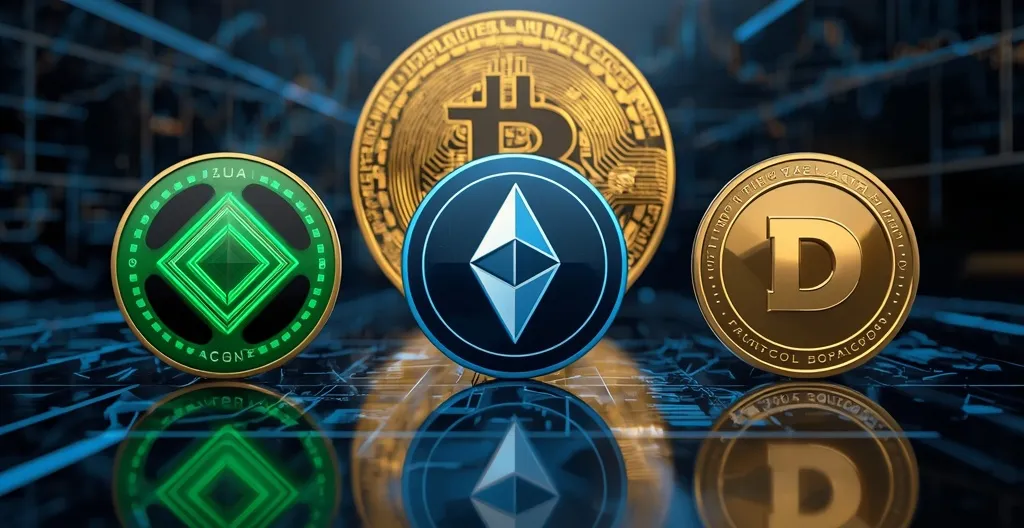
Three AI models were asked the same blunt question: if crypto bounces before the end of 2026, which of Cardano, Solana, or Dogecoin could double first? They did not agree. That alone is a decent reminder that chatbot forecasts are not prophecy, just educated guesses with a slick interface.
- ChatGPT picks Solana first, Dogecoin second, Cardano third.
- Gemini puts Cardano first, Dogecoin second, Solana third.
- Claude says the answer depends on catalysts, not hype.
The setup is simple enough. The comparison uses a December 31 deadline and asks which coin could post a 100% gain first if the market recovers. That sounds neat on paper. In practice, it means the asset needs more than a short-lived bounce and a few green candles to keep traders warm.
August brought some recovery as Bitcoin started to rally again, but that momentum has since cooled. That matters because Bitcoin still tends to set the tone for the rest of the market. If BTC is leading, altcoins usually get some lift. If BTC stalls, altcoin dreams often turn into expensive fan fiction.
The numbers behind the comparison
The starting prices used in the comparison are Cardano at $0.20, Solana at $102, and Dogecoin at $0.08. To double, ADA would need to reach $0.40, SOL would need $204, and DOGE would need $0.16.
The calculations assume circulating supply stays constant. That’s a useful simplification, but it also means the real-world picture can get messier once market liquidity, trader positioning, and fresh demand enter the chat.
It also means a 100% move is not just about the price chart. It’s about whether real money shows up and stays. Crypto loves a narrative. Markets, annoyingly, prefer receipts.
Why Bitcoin still matters most
Before getting too attached to any one altcoin, there’s a bigger force in the room: Bitcoin. The comparison itself notes that Bitcoin’s direction could determine how much support the broader market provides.
That is not a minor detail. A Bitcoin-led recovery can improve risk appetite across the board, but it does not lift every coin equally. Capital usually rotates into the strongest liquid names first, then spills into more speculative corners if the mood stays bullish.
That’s why “the market is recovering” is not the same thing as “this coin will double.” A real move needs sustained buying, not a dead-cat bounce with a fresh haircut.
What ChatGPT sees: Solana has the cleanest shot
In the comparison, ChatGPT ranks Solana first, followed by Dogecoin and then Cardano.
That call makes sense if you look at how Solana behaves when traders are willing to take risk. SOL tends to attract liquidity fast because it already has strong mindshare, active trading, DeFi usage, and a crowded ecosystem that gives people a reason to buy beyond pure speculation.
ChatGPT points to Alpenglow as the main Solana catalyst. The supplied timeline describes a Q3 2026 activation and frames the upgrade as improving transaction finality, the point at which a transaction is considered settled and effectively irreversible. In plain English: faster, cleaner settlement can make a network more appealing to users and traders alike.
That could help. If Solana executes well, the case is straightforward: stronger infrastructure, more confidence, and more capital rotation. But roadmaps do not print green candles on command. Crypto has buried plenty of “this changes everything” upgrades in the same graveyard as half-baked moon targets.
ChatGPT puts Dogecoin second. The logic there is also easy to understand. DOGE does not need a complex fundamentals story to move. It needs attention, volume, and a wave of speculative demand. ChatGPT mentions the Grayscale Dogecoin Trust ETF as a possible access route for investors, and says a confirmed payment integration could help DOGE, but it does not assume an X announcement.
That restraint is refreshing. Dogecoin often runs on rumors, memes, and the market’s collective inability to sit still. It can rip higher quickly. It can also fade just as fast once the crowd remembers it is still Dogecoin.
Cardano lands third in ChatGPT’s view, even with its own upgrade path. The model points to Leios, a Cardano upgrade intended to increase network throughput. The supplied timeline describes a mainnet ready release candidate by late 2026. That could matter if it translates into actual usage and demand, but Cardano’s long-running problem is not lack of technical seriousness. It’s that markets often reward visible traction faster than careful architecture.
What Gemini sees: Cardano gets the edge
Gemini ranks Cardano first, Dogecoin second, and Solana third.
For Cardano to move sharply, Gemini says it would need capital rotation into alternative Layer 1 assets, meaning base blockchain networks like Cardano or Solana, not apps built on top of them, and a recovery through the $0.30 to $0.35 range.
That is not a crazy take. Lower-priced assets can catch speculative bids quickly when sentiment turns, especially if traders think a coin has been neglected for too long. Cardano also has a loyal community, a strong governance narrative, and a reputation for methodical development.
The problem is that “methodical” is not always what the market wants. Crypto traders often reward momentum, not patience. A technically sound project can still underperform if buyers want speed, drama, or simply the next thing their group chat told them about.
Gemini puts Dogecoin second because DOGE remains one of the purest speculative bets in the market. It does not need enterprise adoption or sophisticated DeFi activity to spike. It needs attention and a trading crowd willing to chase it. That makes it volatile, but it also makes it dangerous in exactly the way meme coins tend to be.
Solana ranks third in Gemini’s view, not because the chain lacks upside, but because the model wants stronger proof that the catalysts will actually stick. Gemini points to sustained institutional demand, network stability, and successful execution of Alpenglow as the conditions that would justify a stronger move. In other words, Solana may have the better long-term setup, but Gemini is less convinced it will be the first to hit a clean double on this timeline.
What Claude sees: catalysts first, rankings second
Claude does not give an explicit overall ranking. Instead, it treats the outcome as catalyst-dependent. That is probably the least glamorous answer, and the most believable one.
For Dogecoin, Claude points to a possible September 14 DOGE-1 launch date as the nearest event-based catalyst. It also discusses a possible X Money integration, but treats that as unconfirmed. That caution matters. Crypto markets are notorious for turning speculation into “news” before the facts are even remotely settled.
Claude’s approach is useful because it refuses the fantasy that one upgrade or one headline automatically produces a doubling. It doesn’t. Markets are not vending machines. Put in “good news, ” and you might get a rally, a shrug, or a nasty red candle when traders take profits.
Why the rankings differ
The disagreement between the models mostly comes down to what each one values most:
Solana has the strongest mix of liquidity, speed, ecosystem activity, and market attention. That gives it a real shot if risk appetite returns in force.
Cardano has a strong community and a roadmap that could eventually matter more, but it often needs proof before the market gives it a serious rerating.
Dogecoin can move on pure sentiment faster than either of the others, but it needs the kind of speculative wave that usually arrives with a lot of noise and very little dignity.
In other words: SOL looks strongest if you care about infrastructure and market depth, ADA looks interesting if capital rotates hard into alternative Layer 1 assets, and DOGE looks dangerous in the way only a meme coin can.
And yes, Bitcoin still decides how friendly the backdrop is. If BTC grinds higher, all three have a better shot. If BTC goes sideways, the altcoin crowd is left arguing over catalysts like it’s a court case and the judge is liquidity.
The real lesson here
These kinds of AI comparisons are fun, but they are not a substitute for market structure. A coin doubling is not just about having a nice roadmap or a trendy narrative. It requires buyers who show up, keep showing up, and are willing to pay higher prices without immediately fleeing when the first green candle flickers.
Solana’s pitch is execution. Cardano’s pitch is technical progress turning into actual demand. Dogecoin’s pitch is raw speculation, which is both its strength and its Achilles’ heel.
So if the market does recover, the most likely winner depends on what kind of recovery it is. A broad risk-on move may favor Solana first. A rotation into overlooked Layer 1s could help Cardano. A meme-fueled retail burst could wake up Dogecoin and send it lurching higher for no reason that sounds sensible in daylight.
That is the crypto market in a nutshell: sometimes fundamentals matter, sometimes the crowd just wants to gamble, and sometimes both happen at once while everyone pretends it was obvious all along.
Key takeaways
-
Which coin is most likely to double first?
Solana gets the strongest case from ChatGPT because it combines liquidity, ecosystem activity, and a clear upgrade narrative. Gemini, though, thinks Cardano has the better path if capital rotates into alternative Layer 1 assets. -
Why do the AI models disagree?
They weigh catalysts differently. One model emphasizes Solana’s market strength, another favors Cardano’s recovery setup, and Claude refuses to pretend there is a clean winner without a confirmed trigger. -
Can Dogecoin still surprise traders?
Absolutely. DOGE is the purest speculation play of the three, which means it can move fast when retail demand returns, and then give it all back just as quickly. -
Does Cardano have a real shot?
Yes, but it likely needs more than roadmap progress. ADA needs a shift in market sentiment, stronger capital rotation, and proof that upgrades like Leios translate into actual usage. -
How much does Bitcoin matter here?
A lot. If Bitcoin leads a meaningful recovery, the odds improve for all three. If BTC weakens or stalls, the altcoin double-up dream gets much harder to justify.
FAQ
Can Sol reach $1000 USD?
Yes, Solana (SOL) can theoretically reach $1, 000 USD, but institutional and market analysts project it won’t happen until around 2029 to 2030 under bullish adoption conditions.
Will Cardano ADA reach $10?
Whether Cardano (ADA) can reach $10 depends on massive market cap growth, but most mainstream financial models consider it highly unlikely in the near future.
Which matters more: upgrades or demand?
Demand matters more. Upgrades like Alpenglow and Leios only help if they attract real users, real liquidity, and real buying pressure instead of just a burst of forum excitement.
Are AI price rankings reliable?
Not really. AI can organize the available narratives and catalysts, but it cannot see future flows, future sentiment, or the next wave of market stupidity. That part remains a human specialty.
Further reading
A few side paths worth keeping an eye on, even if the market’s favorite hobby remains making fools out of confident predictions.